Partner Decision-Making on Legal AI Investment and Deployment
Client pressure, not partnership economics, now sets the pace and purpose of law firm AI spending.

Client pressure now drives why partners spend, what that money must deliver, and how quickly firms must move from evaluation to production. Deployment must produce an operational advantage that clients can perceive.
Client pressure as the overlooked driver of law firm AI decisions
The conventional account of legal AI investment starts with partnership economics. It asks whether firms should keep earnings, change distributions, or seek outside financing to pay for technology. Those are genuine decisions, but they concern the movement of money rather than the pressure that makes spending necessary. The distinction changes how investment decisions should be understood. A partnership can debate capital allocation internally while the timetable for action is being set outside the firm.
Litera’s State of Legal AI: Spring 2026 Market Sentiment Report identifies that external force. The report finds that a majority of firms say a client directly influenced an AI investment decision in the last twelve months, while only a small minority describe investment as entirely internally driven. Internal economics still constrain the response. They no longer fully explain why firms have to act.

How client expectations shifted from cost efficiency to demonstrated AI capability
The report frames the client’s underlying question as “Is my lawyer actually better because of AI?” That demand is more exacting than an inquiry about software subscriptions. It asks whether technology has improved the service the client receives, rather than whether the firm has joined the market for new tools. Access alone does not answer the question. The distinction places the burden on firms to explain what has changed in the work.
Burford Capital’s June 2026 analysis identifies the economic pressure behind that demand. Corporate legal departments face higher billing rates and rising legal costs, and they expect greater efficiency and faster turnaround in return. Their interest in AI is therefore connected to the performance of outside counsel. Casey Flaherty of Baretz+Brunelle expresses the competitive consequence in the report as “unarticulated value is invisible value.” A firm with a technology-enabled advantage strengthens its position only if it can make that advantage intelligible to the client comparing counsel.
Why most firms cannot yet answer the client's question
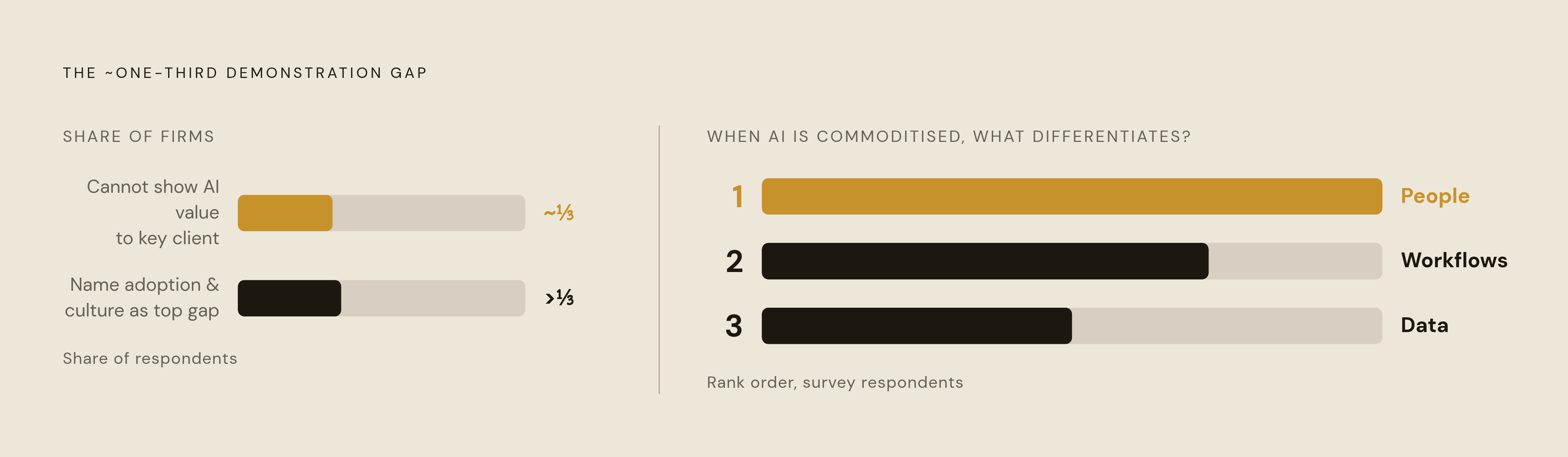
The report finds that nearly a third of firms cannot confidently demonstrate AI value to their most important client. That is a substantial demonstration gap at precisely the relationship where a firm needs a convincing answer. The finding establishes a commercially significant weakness. Whatever value exists has not become something the firm can confidently show.
The same research identifies adoption, training, and culture as the biggest gap in AI strategy for more than a third of firms. When respondents considered differentiation in a market where competitors have the same underlying AI, they pointed to people, workflows, and data, in that order. Firms must use the technology they have to improve their work enough for clients to see the difference.
Judging client pressure by whether clients audit AI use sets too narrow a test. A formal audit is not required for a client’s expectations to affect a funding decision, and the reported investment influence shows that this pressure already has concrete consequences.
How the partnership model turns client pressure into a capital problem
Burford describes most law firms as cash-in, cash-out businesses that distribute profits annually, leaving those profits unavailable for future investment. Substantive AI spending therefore competes directly with current partner income. Every dollar retained is unavailable for distribution. That trade-off becomes harder when top rainmakers are regularly courted by competitors and changes to their economics have consequences for retention.
The tension is not simply resistance to technology. Partners are being asked to fund what the firm will need in the future through a structure built to pay out current earnings, while it is still unclear when the investment will pay off. Client pressure accelerates the need to spend without removing that uncertainty.
Burford names portfolio financing, law firm equity solutions, and MSO structures as new ways to fund AI investment separately from annual distributions. Their emergence reflects the financing problem rather than resolving the merits of any particular deployment. Capital structure determines what resources a firm can commit and when. Client demand determines why postponing that commitment may become increasingly difficult.
What the largest firms are actually funding and why it differs by scale
The choices firms make about investment depend in part on their size. A small number of firms can seek to own proprietary platforms, while most invest through partnerships. Those paths require different resources and place different demands on the firm’s balance sheet. Neither is inherently the more serious response. Both can be ways to meet the same client demand with different limits on what firms can spend.
Burford describes A&O Shearman’s expanded relationship with Harvey to develop tools for antitrust, cybersecurity, fund formation, and loan review. It also describes Freshfields’ strategic partnership with Anthropic. Latham & Watkins licensed Harvey firmwide in August 2025, while Linklaters rolled out Legora in September 2025. A vendor relationship does not, by itself, describe how deeply technology will be incorporated into legal work.
The build-versus-partner debate is consequently a resource question before it is a strategic philosophy. Scale affects which paths are available, and client value depends on what the firm can put to work through the arrangement it funds.
It asks whether technology has improved the service the client receives, rather than whether the firm has joined the market for new tools.
Why AI investment has not yet changed how much work firms win
The firms that have invested most publicly in AI have not taken measurably larger shares of announced deal work. This is an uncomfortable limit on the investment case. Public commitments cannot yet be treated as evidence that AI spending wins more mandates or a greater share of transactions. For partners weighing the evidence, doing current work better makes a stronger case for investment than assuming it will bring in more work.
The measurement itself has important limits. Kirkland & Ellis’ near-absence from 2026 deal announcements despite its $500 million commitment is a data artifact. Firms that announce less appear less in public data. Announced deal work is therefore an incomplete proxy for the commercial impact of AI, and the absence of a visible gain cannot establish that investment has produced no benefit.
That caveat limits what partners can conclude in either direction.
Why ROI ranked last even as client pressure ranked first
The report finds that ROI ranked last on two separate survey questions, while time recaptured rather than cost avoided was the value story that resonated with partners. Firms are spending in response to external expectations without making measured return the leading basis for their decisions. The two findings should not be collapsed into a claim that returns are irrelevant.
Time recaptured speaks directly to partner workload. Eric Friedman, former chairman and CEO of Skadden and a Litera board member, explains the external challenge in the report. Clients increasingly expect to share in the AI productivity dividend, and they have the leverage to ask for it. Capacity released inside the firm is not, on its own, evidence that they have received that share.
This difference matters when clients or boards look closely at the results. Faster delivery, lower cost, or better work translates saved time into an outcome. Workload relief alone does not. A firm unable to demonstrate value to its most important client also lacks a convincing bridge from time recaptured to a P&L line. Deployment decisions must therefore address how productivity becomes observable performance.
What client pressure actually demands from AI deployment — and why pilots don't deliver it
An evaluation can establish whether a tool deserves further attention. Showing that the firm can keep doing better work for clients takes production deployment, where systems do real work and are judged against clear expectations. Most legal AI efforts have not yet reached that stage. The pilot-to-production gap is consequently a client relationship problem as well as a technology problem, because evaluation activity cannot supply the evidence clients are requesting.
The operational response requires deliberate investment in workflow integration, governance, and measurable output standards. Those commitments give deployment a purpose beyond making tools available to individual lawyers. They define the work being performed and the basis on which its results can be judged. Without that link, a firm may be able to describe how it uses AI but still be unable to explain how it affects service.
Enterprise AI agents built to handle complete legal workflows show the standard that firms are being pressed to meet in production. These workflows include legal case briefing, contract review against playbooks, and regulatory filing prep. The distinction is bounded execution with auditable outputs. Such systems go beyond helping an individual lawyer to own and run a defined workflow end-to-end, so deployment is judged by how well the work is done.
How AI investment has become a lateral recruiting signal alongside a client signal
Lawyers also read AI investment as a signal of a firm’s operational seriousness. A firm’s response communicates something to prospective lateral recruits as well as to clients. Delay therefore has consequences beyond forgone efficiency. It can weaken the firm’s competitive position in both client relationships and attorney quality, the two dimensions on which long-term firm health depends. The pressures strengthen each other but differ in what they ask of firms, since clients want better service while lawyers weigh how committed a firm they may join is to improving its work.
What partner decision-making on legal AI should look like given these pressures
The lesson for partners is to begin with the production requirement rather than an abstract internal ROI case. The first decision is what a specific practice area needs in production, with governance, measurable outputs, and client-visible performance, and by when. That gives the investment discussion a defined object. It also places the deadline in its proper context, since client expectations are being shaped by firms already deploying in production.
Partners should then assess the differentiators they can control. Custom workflows, proprietary data, and people able to deploy AI on real work therefore deserve attention in the funding decision. Whether the firm builds, buys, or partners depends on its resources and the work necessary to reach production.
Firms should start with a structured AI Operations Audit before putting in more capital. It should assess how far the firm has come in workflow integration, data readiness, governance, and defining outcomes it can measure. That assessment separates an operational investment case from an expectation that purchasing technology will create value by itself. It also establishes the basis for the client-facing evidence the firm needs to produce.
The window in which evaluation-stage activity is an acceptable answer to a client’s AI question is closing. Partners should treat deployment as an operational commitment with defined workflows, measurable outputs, and governance standards. The final test is the line from that commitment to value the client can perceive.
Sources
- The AI arms race in law requires a capital strategy
Provided the analysis of cash-in, cash-out partnership economics, new financing structures, and examples of large-firm AI partnerships.
- 85% of Law Firms Say Clients Are Driving AI Investment Decisions, New Litera Survey Finds
Supplied the survey findings on client influence over AI investment, the demonstration gap with top clients, the ranking of ROI, and the differentiators firms cited.