AI Agents for Legal Case Briefing in Litigation Workflows
Agents manage litigation workflows by connecting dependent tasks while preserving attorney judgment.
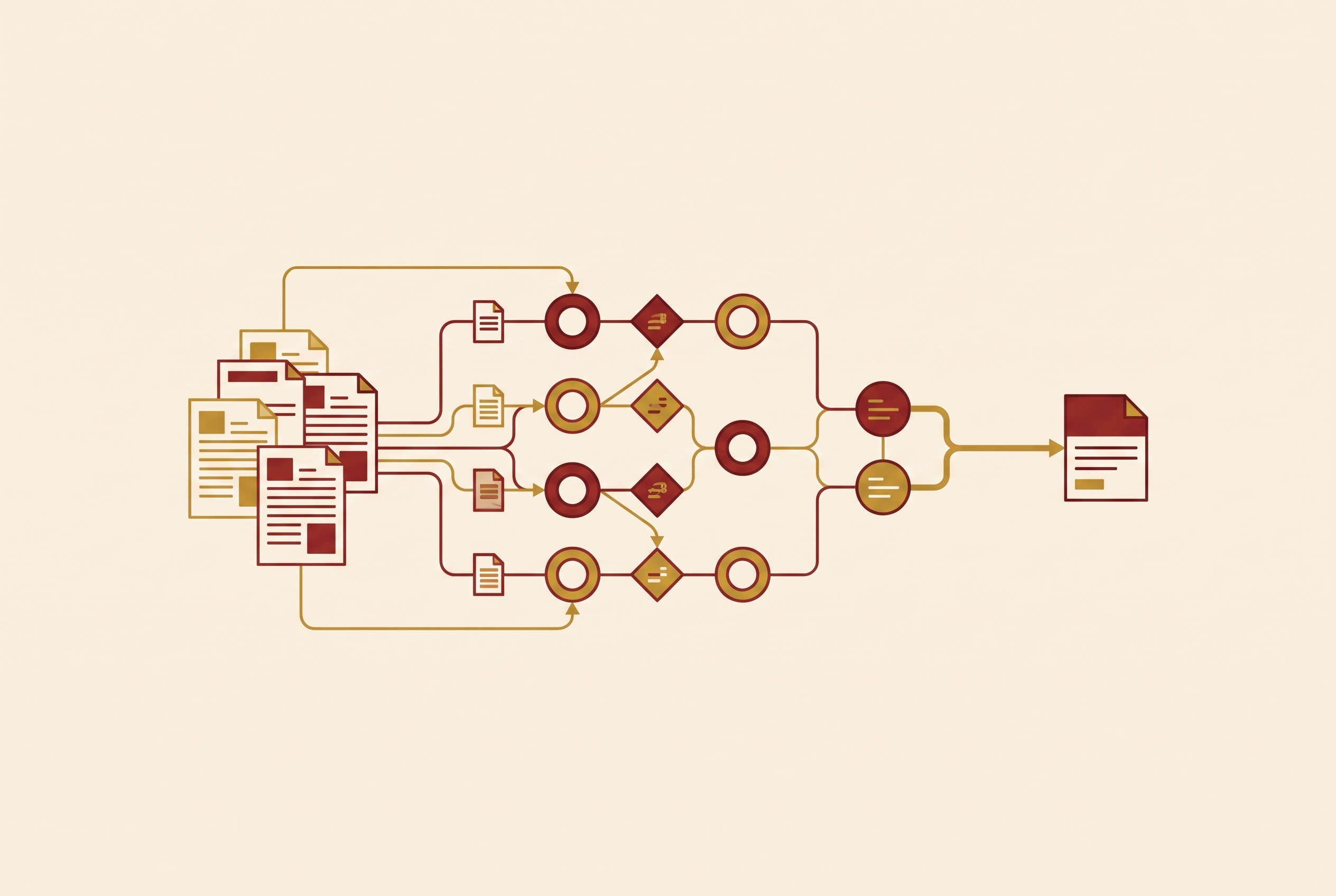
AI agents for legal case briefing are most valuable when they manage the connected work between raw case files and litigation-ready work product. Their advantage is reducing foundational preparation across the workflow while preserving attorney judgment at consequential decision points. That advantage depends on source traceability, review that must take place, secure infrastructure, and measures of the whole process that include time saved on each task.
Why standalone LLMs fail litigation workflows and what agents fix
Litigation requires more than a well-reasoned answer. It involves dependent tasks, procedural requirements, and sources whose authority must be established before their contents support an argument. A standalone LLM responds to a prompt, but that response does not itself manage the movement from file intake through research, drafting, and review. Even strong reasoning cannot compensate for missing documents, outdated authority, or an unverified citation.
Damien Charlotin’s public tracker at HEC Paris and Sciences Po Paris had logged hundreds of AI hallucination cases worldwide by mid-2026, with the majority in US courts. These failures make verifiability a professional requirement. LLM Agents in Law: Taxonomy, Applications, and Challenges identifies planning, memory, and tool use as the capabilities that distinguish agents from standalone models. An agent can plan work, carry out the steps, check the results, and change course. That architecture addresses multi-step consistency and access to authoritative sources, although it does not make the resulting work inherently correct.
What a litigation case-briefing workflow actually contains, step by step
Raw case files must be received, parties, dates, and obligations extracted, and documents routed to the right matter. Incorrect party identification or a missed document can propagate through later work product. The first handoff therefore tests more than extraction accuracy. It checks whether the research and drafting that follow start from the right record.
Legal research builds on that record through distinct tasks, including case law search, statutory analysis, citation verification, and judicial profiling. Each requires verified sources. Motion practice then converts the research and facts into first-draft sections and fact statements, with citations traceable to source documents. The transition is a substantive dependency. A draft can read well even when the record behind it is incomplete or it gets the authority wrong.
Settlement and mediation support require another synthesis. Negotiation memos combine litigation posture, exposure, and comparable outcomes, while trial preparation turns the accumulated record into witness packets and direct and cross-examination outlines. These outputs depend on the accuracy of earlier work. Throughout the pre-trial period, eDiscovery and litigation holds add high-volume, procedurally rigid tasks, including legal hold notices, custodian tracking, and first-pass document review. An agent’s value grows with the number of connected steps it can execute without human re-initiation, but only if each handoff preserves the information the next step needs.
How the agent architecture handles each stage without losing the thread
Planning breaks a briefing request into subtasks and puts them in order. The agent manages dependencies rather than waiting for another prompt to move from research to drafting. Memory keeps the matter context across those tasks, including prior filings, deposition summaries, and judicial tendency data. A motion draft can therefore reflect the case history.
Tool use connects that sequence to legal databases, citation validators, and document stores. Instead of relying only on information embedded in the model, the agent retrieves material from the firm’s document corpus and verified legal sources. Citation verification is a necessary part of that process. The Oregon sanction and the Nebraska indefinite suspension of attorney Greg Lake, whose brief had the overwhelming majority of citations flagged as defective, establish the professional consequences of unverified AI citations.
The plan-act-observe loop connects these capabilities during execution. After each action, the agent checks the result, adjusts, and proceeds, allowing it to manage dependencies that a single chatbot response cannot. Audit logging records automated actions with timestamps and decision paths so that the sequence can be examined for professional responsibility compliance or if work product is challenged. A system that generates a draft but cannot account for the steps behind it has not demonstrated the same workflow control.
The systems litigation teams are using today and what each one actually does
Thomson Reuters CoCounsel provides an AI research and drafting layer built on Westlaw and Practical Law, following its acquisition through Casetext in 2023. Its grounding substantially reduces the risk of citing cases that do not exist, while the risk of mischaracterizing a holding remains. Attorneys must still read the cited cases. Hill v. Workday, involving a lawyer using CoCounsel, illustrates why access to authoritative material does not remove the need for attorney review.
LexisNexis Lexis+ AI / Protégé grounds research in the LexisNexis corpus and uses Shepard’s Citations for validation. It offers conversational legal research and modes for specific practice areas, and it can produce drafts with citations and summarize documents. An add-on integration with Lex Machina provides litigation analytics on judge tendencies, opposing counsel track records, and damages data that CoCounsel does not offer. Grounding still does not guarantee citation accuracy. A lawyer using Protégé was sanctioned in Tekoma Chaney v. Transdev Services for fabricated case law, which shows that access to databases and tools that check citations cannot take the place of a thorough review.
NexLaw targets U.S. litigation teams with an end-to-end agentic platform supporting workflows from discovery through courtroom assistance, with traceability anchored to case files. Its stated scope differs from the research-and-drafting emphasis of the other systems. CoCounsel and Lexis+ AI are strong at the research-and-citation stage, but neither is designed to manage the full pre-trial workflow from intake through trial preparation. Research depth, litigation analytics, and workflow coverage serve different needs, and strength in one does not establish strength across all three.
Damien Charlotin’s public tracker at HEC Paris and Sciences Po Paris had logged hundreds of AI hallucination cases worldwide by mid-2026, with the majority in US courts.
Where attorney judgment must stay in the loop and why agents are not designed to remove it
Delegating connected workflow steps raises a legitimate concern. If a system can proceed without repeated prompts, human control cannot depend on an attorney remembering to interrupt it. Legal strategy, final argument framing, settlement authority, and any filing submitted to a court remain consequential decision points requiring attorney review. The useful boundary is between preparing the basis for a decision and making or authorizing that decision. An agent can assemble the research and draft the argument without receiving authority to submit it.
Well-designed agents enforce that boundary through approval checkpoints. The system produces work product and halts for attorney approval before anything consequential is submitted. The sanction cases show what this design aims to prevent when AI output is filed without a thorough review. The human confirmation checkpoint failed to provide the scrutiny required before downstream use.
The survey recommends that legal professionals supervise and review agent outputs before deployment or downstream use. In practice, this changes how attorney time is allocated. Lawyers spend less time on foundational research and drafting and more on examining the resulting work, resolving uncertainty, and approving its use. That review still includes reading cited authorities and assessing whether the argument fits the record. Automation reduces preparation work without transferring professional accountability to the system.
Why privilege, data security, and governance determine whether a deployment survives
Attorney-client privilege constrains the infrastructure beneath the interface. Using consumer-tier products such as ChatGPT Free/Plus or Claude Free/Pro/Max can waive privilege if client data is used for model training. Public APIs from the same providers do not use data for training by default, so the underlying provider’s data handling terms are as important as the agent’s visible features. In response, the market offers private agents hosted in isolated cloud environments built to keep data under the firm’s control. Deployment architecture is therefore part of the confidentiality decision.
DecodingTrust-Agent Platform research documents systematic agent vulnerabilities across domains including legal, with prompt injection, tool injection, and environment injection among the attack vectors. These threats concern the agent’s interactions with instructions, tools, and its operating environment. A deployment must address them before production use. Trust in access controls needs to be backed by evidence that they hold up under attack.
Governance failures can prevent deployment even when model performance is adequate. Missing audit logs leave automated actions difficult to reconstruct, unclear ownership leaves responsibility unresolved, and poor data readiness can deny the agent access to the structured, clean case files it needs. Data readiness is a frequent point of failure. Organizations that skip a pre-deployment assessment can discover these constraints only after implementation work has begun. In that situation, improving the model does not repair the inaccessible or disorganized record.
Establish verified controls, assess data readiness, and designate ownership before go-live. A dedicated owner provides a clear point of responsibility for a program that otherwise spans legal work, data handling, and technical operations. Audit completeness and access protection then become conditions that can be examined. These requirements set the practical boundary of deployment. A capable agent is not deployable merely because its drafts read well.
How to measure whether a legal case-briefing agent is delivering before and after deployment
An AI Operations Audit before deployment establishes the baseline for evaluating returns. It assesses data readiness, governance, and process maturity before automation changes the work. Without that starting point, a firm lacks a reliable denominator for its ROI calculation. The measurement unit should be the briefing workflow. Faster retrieval saves time on research, but that alone does not show whether a reviewed brief is finished sooner or attorneys have more time they can use.
Business-value metrics include cycle time per brief, matter throughput, and output volume per attorney. Quality metrics include citation accuracy rate, reviewer acceptance rate, rework frequency, and escalation rate. These measures belong together because faster production has limited value if correction consumes the time saved. They also connect performance assessment to professional exposure. Citation accuracy and review outcomes test whether the workflow produces dependable work.
Risk and cost provide the remaining dimensions. Policy violations, incidents that expose sensitive data, and how complete the audit logs are show whether the workflow stays within its controls. Model inference cost and infrastructure cost must be considered together with attorney time recaptured and reallocated. Reallocation is an essential distinction, because time saved on preparation does not automatically become additional capacity or financial return. The comparison before and after deployment must account for what happens to that time.
The most plausible concentration of measurable returns is foundational document work. AI tools can cut much of the time needed for large-scale document review, and they can also save attorney hours on routine research and briefing preparation. The healthcare parallel is instructive because agents perform best there in high-volume administrative and document tasks. In litigation, the corresponding test is whether automation improves the connected path through preparation, review, and completion. Agents that manage that path can produce workflow-level ROI evidence, while point solutions leave the firm with task-level gains that are harder to translate into a defensible investment case.
Sources
- DecodingTrust-Agent Platform (DTap): A Controllable and Interactive Red-Teaming Platform for AI Agents
Documented systematic agent vulnerabilities including prompt injection, tool injection, and environment injection attacks relevant to legal deployments.
- LLM Agents in Law: Taxonomy, Applications, and Challenges
Provided the taxonomy of planning, memory, and tool use as the capabilities distinguishing AI agents from standalone LLMs, cited directly in the article.
- Agentic AI Enterprise Adoption 2026: 72% Production Proven
Informed the discussion of governance failures, data readiness gaps, and the recommendation to establish controls and designate ownership before deployment.