BigLaw AI Vendor Deals That Changed Firm Operations
Firms are moving beyond software licenses into AI partnerships that reshape how they practice law.

Law firms have bought technology for decades, but the agreements signed between 2025 and 2026 are a different kind of transaction. These are not software licenses or year-long pilot subscriptions that a firm's IT department renews or drops without much notice. They are multi-year co-development partnerships with major AI platforms, structured so the firm and the vendor build something together rather than one simply selling a product to the other. That distinction matters because it changes what each side is actually buying and selling: not a tool, but a claim on how the firm will practice law going forward. Kirkland chair Jon Ballis put the underlying logic plainly to the Financial Times: widely available AI tools are "raising the floor for everyone" in the legal industry, but "we don't get hired for the floor." Commodity tools help every firm equally. They help no firm competitively, and that is the condition these deals are built to escape.
The three deals that set the terms of the current wave
Three partnerships announced in 2025 and 2026 define the current moment, and each deserves to be understood on its own terms before any pattern gets drawn across them.
Kirkland & Ellis and Palantir announced a multi-year technology partnership in June 2026 to co-develop an AI platform aimed at the private equity fund formation lifecycle, the process by which PE clients raise capital from investors. The platform lets Kirkland lawyers "securely scale" institutional knowledge and run complex legal workflows across the full span of fund formation and fundraising, replacing the separate tools once used to handle each piece. Kirkland has since widened the relationship, continuing to co-develop tools with Palantir and building a standalone fund formation product it intends to sell to other firms.
Freshfields and Anthropic announced their own partnership in April 2026. Under the arrangement, Freshfields gets early access to Anthropic's future models, a structural edge in a field where the gap between model generations keeps shrinking and the firms that get there first keep more of the advantage.
Debevoise & Plimpton and Legora rounded out the wave with a widely covered partnership in which Debevoise built Legora into its working processes. All three deals got substantial press coverage. What separates them is not how loudly they were announced, but what they were built to do once the announcement faded.
Deals that changed operations versus deals that changed press coverage
The deals that actually changed how a firm operates share one structural feature: they were built around a complete workflow, not a single task lifted out of a longer manual process. Kirkland's Palantir platform covers fund formation from start to finish. Kirkland built it as a sellable product, beyond the internal efficiency gain it also delivers. The Freshfields deal works differently. Freshfields is a co-developer of tools that Anthropic and Freshfields may eventually license to other firms, so part of the payoff is commercial and part of it sits in the future. The near-term gain is early access to better models, not an immediate change in how Freshfields associates spend their days. That is not a lesser outcome, but it is a different one, and treating it as equivalent to a workflow deployment overstates what it has done so far operationally.
The honesty of this dynamic was captured by Esther Chiang, who told the American Lawyer that peers of Kirkland in the private equity space feel pressure to respond: "I've heard from people at Kirkland's peer firms in the private equity area that they feel they need to respond somehow." That is competitive signaling doing what it is supposed to do, prompting rivals to act out of concern for being left behind rather than out of a clear-eyed read on whether their own workflow needs the same fix. Signaling deals are not worthless. They shape how clients and competitors perceive a firm's seriousness about AI, and that perception has its own market value. But signaling is not the same as transformation, and a firm evaluating its own AI strategy should be able to tell the two apart.
A useful counterexample comes from outside the marquee partnerships. Fish & Richardson built its own tool, FishStream AI, after testing third-party products that did not fit how its attorneys actually worked. The firm designed FishStream specifically for patent prosecution, with legal judgment, strategy, and final work product kept firmly in the hands of Fish professionals under a human-in-the-loop model. No major AI lab's name is attached to it, and it never generated a Financial Times headline. But it was purpose-built around one complete workflow, patent prosecution, and that specificity is precisely what the splashier deals are also chasing, with mixed success.
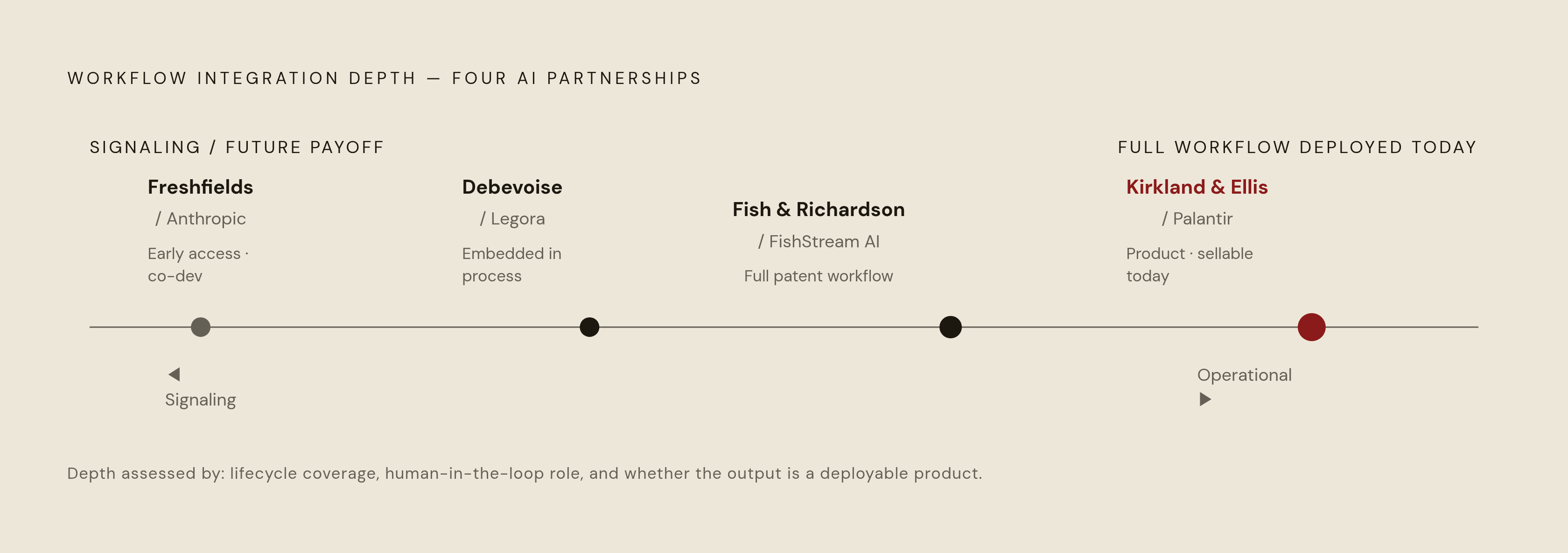
Workflow-Level Integration in Legal Work
Firms that describe a tool as sitting inside a specific stage of legal work, rather than as a general assistant available for anything, report real adoption.
Kirkland's platform is a clear case. It embeds senior partner judgment directly into the system, which shortens the drafting and negotiation cycle for fund documents and side letters, a task that used to consume a large amount of associate time at every round of revisions. Because the judgment itself, not just the document template, is built into the software, the platform can carry a negotiation further before a human needs to intervene.
The same logic explains why narrower, specialist tools have found steady adoption inside their own domains. Kira handles contract review and due diligence, doing one job across thousands of documents in M&A and real estate deals. Everlaw handles e-discovery and document review at the scale a major litigation requires. Neither tool tries to be a general assistant. Each is built around one workflow, done completely, which is exactly the trait the Kirkland and Fish & Richardson examples share.
Microsoft Copilot makes the contrast obvious from the other direction. It sits inside every Microsoft 365 email and document an attorney opens, at very low added cost, and nearly everyone touches it. But it was not designed around how legal work actually moves from intake to filing to negotiation to close, and its presence everywhere has not embedded it anywhere, so ubiquity alone does not equal workflow integration.
Where the deal announcements fall short
The competitive map has not yet shifted in a way that shows up in deal data. Across a large sample of BigLaw deal announcements tracked over time, firms with the loudest AI programs have not captured a measurably larger share of announced deals once their tools went live. Deal share has stayed roughly where it was.
Kirkland is the clearest case. It runs the largest publicly disclosed AI program in the industry, at $500 million, yet it appeared on very few deal announcements in 2026 in the tracked dataset, down sharply from prior years. Deal announcements are a marketing choice, not a complete record of a firm's business, so that drop mainly reflects how firms choose to publicize their work.
Clifford Chance's job cuts show the other side of that story. One of the largest international law firms, it announced job cuts last year and cited rising AI adoption as a reason. That is a sign that efficiency gains are already reaching headcount in at least one major firm, even while named deal teams at other firms have held steady. The absence of a market-share shift does not mean the investment has failed; the payoff is landing somewhere other than the scoreboard most people are watching.
Freshfields and Anthropic announced their own partnership in April 2026.
Where the returns from workflow-level AI are going
The gains from workflow-level AI are currently being absorbed as added capacity and margin rather than as headcount cuts or a larger slice of the deal market. Three destinations account for most of that return: firms are taking on more work per attorney without growing headcount at the same rate, they are keeping more of each matter's value as margin rather than passing the efficiency on as lower client fees, and they are using AI capability itself as a selling point in competing for new mandates, separate from whether it shows up in the deal tally.
The clearest evidence that this is a real contest, not just an internal efficiency story, comes from where lawyers themselves are moving. AI companies are hiring directly out of BigLaw. Data on the first half of 2026 shows dozens of lawyers moved from large firms to AI companies, most of them associates. That flow runs in both directions: firms are investing in AI partly to make the day-to-day work less grinding and more interesting, which makes an AI company's pitch to a talented associate less of an automatic win. The investment functions as a retention tool as much as a productivity one, and firms that treat it only as the latter are missing half of what is actually at stake.
The structural threat these deals are accelerating inside firms
The organizational consequence of this shift reaches further than margin or retention. BigLaw's business model has always rested on a leverage pyramid: a relatively small number of partners supervise a much larger base of billing associates, who learn the craft by doing the drafting, research, and document review that senior lawyers do not have time for. Embedding senior partner judgment directly into AI systems, as Kirkland's platform does for fund formation, compresses exactly the body of work that has always trained the next generation of lawyers. The deals that go deepest into a workflow are moving this faster than the industry has openly acknowledged.
Stanford Law professor David Freeman Engstrom described the dynamic to Axios in direct terms: firms are racing to "extract the knowledge of their lawyers" and build it into AI workflows. That means "getting ready for a world in which you need fewer human lawyers. The near-term signs line up with that reading, even if none of them alone proves it. A major 2025 legal market report found that firms have reduced the pace of associate hiring or cut the size of their summer associate programs. Clifford Chance's London job cuts, cited to AI adoption, point the same direction.
University of Houston Law Center professor Nik Guggenberger says junior legal work has always served two purposes at once: billing the client and training the associate. If AI absorbs the work that used to train junior lawyers, there is no material left for them to practice on, and a profession made up mostly of partners and AI agents becomes very hard for anyone new to enter. The lawyer who survives this shift, in Engstrom's description, functions as a "symphony conductor," assembling AI outputs, data, and legal judgment into a finished position in place of reviewing documents line by line. That is a genuinely different kind of lawyer than the one BigLaw's apprenticeship system was built to produce, and no firm in this wave of deals has yet said how it plans to train one.
What firms and their AI partners have not yet solved: production readiness and governance
The distance between announcing a marquee AI partnership and running a production-ready system on live legal work is where most enterprise AI efforts stall, and BigLaw has not found a way around that general pattern. A signed partnership and a press release are the easy part. Handling real matters end to end, reliably, takes years and rarely makes news on its own.
Legal AI carries a failure mode specific to the profession. A large language model used for legal review without a retrieval-augmented architecture grounding its outputs in verified source documents will produce hallucinated citations, citing cases or statutes that misstate or invent the law. That is a documented pattern, not a rare edge case, and it is a direct liability risk in a profession built on citing authority correctly. Any legal AI deployment that touches case law or statute has to treat citation verification as a hard requirement, not an optional safeguard added later.
Governance is the second unresolved gap. A large share of enterprises planning agentic AI deployments currently lack a mature governance model for how those agents are supervised and held accountable. That gap matters more in law than in most other industries, because when an AI system produces a wrong output, the liability lands on the supervising attorney, not on the vendor that built the tool. A firm can co-develop the most capable platform in its practice area and still be exposed if it has not built the accountability structure to match.
What a Vendor Deal Needs to Deliver
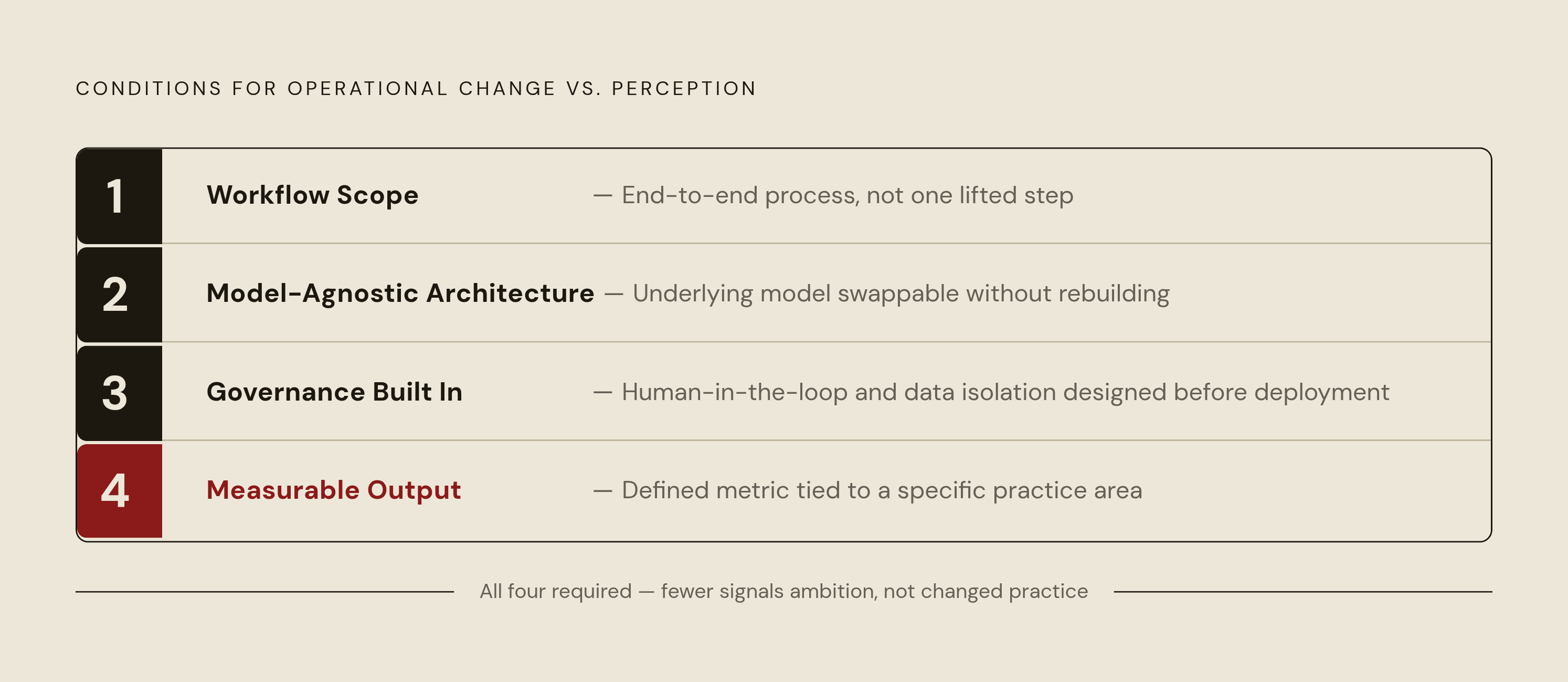
The deals examined here point to four conditions that separate a partnership which changes how a firm operates from one that mainly changes how the firm is perceived: workflow scope, model-agnostic architecture, governance built in from the start, and a measurable output tied to a specific practice area.
Workflow scope means the partnership has to cover a complete process, fund formation from intake to close, e-discovery from collection to production, patent prosecution from prior art search to office action response, rather than one step lifted out of a longer manual chain. Automating a single piece of a workflow creates only partial value, and it often adds new coordination overhead where the handoff between the human and the AI system is not clearly defined.
Model-agnostic architecture matters because dependency on a single foundation model ties a firm's operating infrastructure to that provider's pricing, roadmap, and risk decisions. Kirkland's platform was built so the underlying model can be swapped without rebuilding the system around it, a deliberate choice against lock-in.
Governance has to be designed in before deployment, not patched on after a mistake. Because liability for a wrong output in legal work falls on the supervising attorney, the firms whose AI systems are holding up under real use are the ones that built human-in-the-loop accountability and data isolation into the architecture from day one.
Finally, the partnerships that can show real operational change are the ones with a defined metric attached to a specific practice area, fund formation turnaround time, hours spent on document review, time spent on research, something a firm can measure before the deployment and again after. A partnership announced without that kind of metric is more likely to remain a signal of ambition than a record of changed practice, and the firms getting the clearest return from this wave of deals are the ones that built toward a number, not just toward a headline.