Law Firm AI Pilot Announcements Versus Production Outcomes
Most law firms are announcing AI adoption they haven't actually deployed to production work.

Law firms are announcing AI adoption faster than their internal operations can substantiate it. Best Law Firms surveyed nearly 5,000 U.S. law firms and found that 70% are either exploring generative AI or running pilots, while nearly a quarter of large firms say they have fully implemented generative AI tools across multiple practice areas. That contrast looks like an industry in motion, but it conceals how much of that motion is still confined to test environments rather than live production work. The 8am 2026 Legal Industry Report found that use by individual legal professionals more than doubled in a single year, even as the majority of firms still lack formal AI policies or training programs to govern that use. A lawyer who adopts a tool independently has not made the firm an AI adopter; that lawyer has made a personal choice that the institution has yet to absorb, measure, or own. The pattern across the data is not one of firms misrepresenting their progress but of firms conflating exploration with deployment, two categories that look similar in a press release and behave nothing alike on a Tuesday afternoon when a contract has to move through approval.
Why pilots succeed and then stall when they meet production conditions
Pilots are built to succeed, and that is precisely what makes them poor predictors of what happens next. Once volume exceeds what the original team can manage, it must flow through a real approval chain that was never redesigned to accommodate a new participant.
The AI did not fail technically. RAND also found that AI projects fail at roughly twice the rate of comparable non-AI IT projects, a gap that has little to do with model quality and everything to do with what organizations do, or fail to do, around the model.
The organizational conditions that consistently block legal AI from reaching production
Legal and procurement AI deployments face organizational obstacles that compound in ways that make the pilot-to-production threshold harder to cross than in almost any other function. That caution is professional judgment doing its job, not institutional resistance to change, and treating it as the latter misreads why legal adoption moves slowly. Redesigning a workflow between four teams is a negotiation, and negotiations take longer, carry more political risk, and are far easier to abandon halfway through.
The governance gap compounds the operational one. Thomson Reuters Institute's analysis frames this forward rather than backward: firms running pilots in 2026 without resolving ownership, accountability, and workflow integration are building toward a 2028 failure, not a 2026 success. Diffused ownership is the structural cause of all of this: no single person has the authority to fix what breaks in production. Firms also face documented court sanctions and error rates tied to production use of legal-specific AI tools, a fact that does not argue against deployment but does mean the proof standard required before a tool is handed production responsibility is higher in legal than in most other industries.
What separates firms that reached production from firms that stayed in pilot
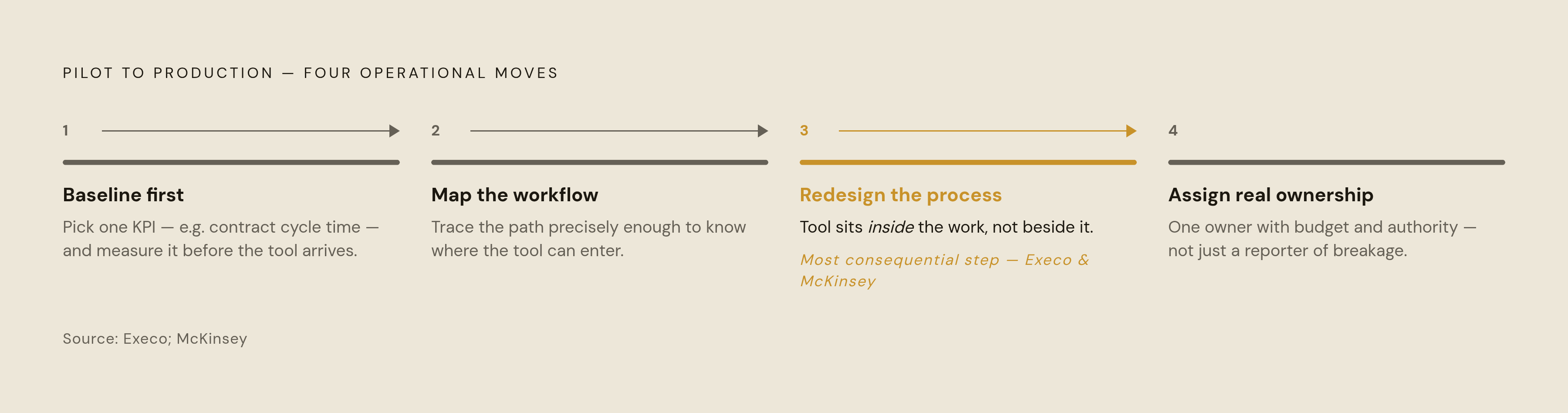
The firms that moved legal AI from pilot to production shared four operational practices, and none of them had anything to do with which vendor or model they selected. Execo identifies these four moves. Each one requires budget, mandate, cross-functional access, and executive backing to execute, so few firms complete all four. The sequence starts with setting a KPI baseline before the tool ever arrives: choosing one number that has to change, whether that is cycle time on a contract type, the cost of processing a document at full volume, or the share of agreements signed without legal review, and measuring that number while the old process is still running. The third move, and the one Execo and McKinsey both identify as most consequential, is redesigning the process so the tool sits inside the path of the work. The fourth move, and the one that makes the first three possible, is giving ownership to someone with real budget and authority, because legal operations and procurement leads cannot carry this alone and the owner has to be able to change things when production breaks, not simply report that it broke.
An enterprise AI agent built to own a complete step in an approval chain, rather than augment a step that stays exactly as it was, is what closes that gap in practice. Thomson Reuters Institute's analysis supports the broader pattern with numbers: firms with a visible AI strategy were 1.9 times more likely to report revenue growth compared to firms with informal or ad-hoc adoption, and were also substantially more likely to report at least one form of ROI compared to firms with no significant AI adoption plans.
The Pilot-Production Gap as a Competitive Threat
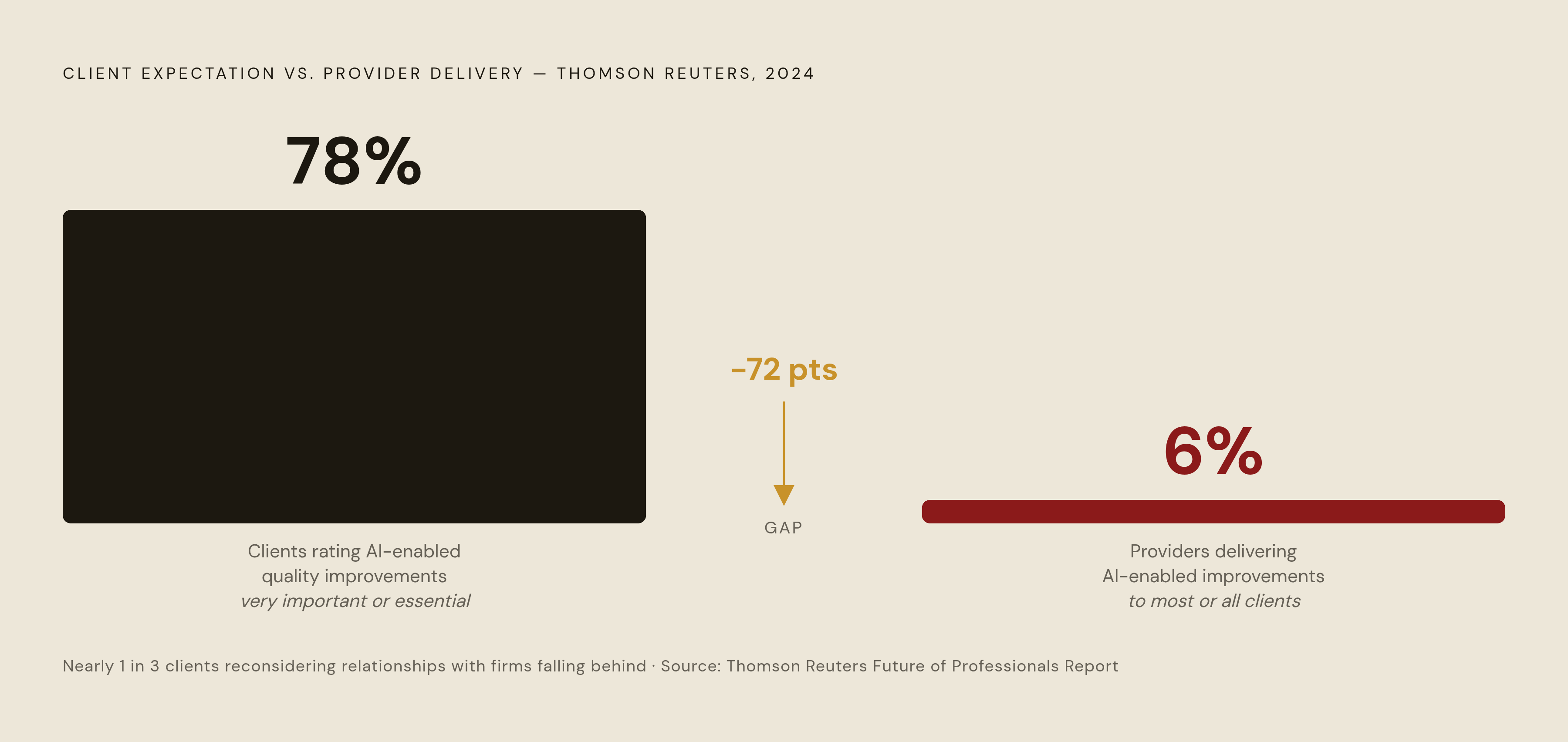
Corporate clients have stopped treating legal AI as an experiment they are willing to wait on, and that shift has turned an internal operational gap into an external competitive one. Thomson Reuters' Future of Professionals Report found that 78% of corporate clients said AI-enabled quality improvements are very important or essential, while only 6% said most or all of their providers currently deliver them. Nearly a third said they were reconsidering relationships with firms that are falling behind on this front. That skepticism is not speculative. The Association of Corporate Counsel's 2025 survey found that a majority of companies had seen no clear savings yet from outside counsel who use AI, so clients' skepticism is grounded in invoices and turnaround times that never improved. The client, in other words, is the production test that matters most, and firms that cannot pass it are already watching the consequence: clients building the capability themselves, in-house, and shrinking the scope of work available to outside counsel in the process.
That caution is professional judgment doing its job, not institutional resistance to change, and treating it as the latter misreads why legal adoption moves slowly.
What an AI Operations Audit Reveals
A technology evaluation asks whether a tool works. An AI operations audit asks whether the organization is ready to make any tool work once it reaches production, and a six-figure AI budget produces results or disappears into dashboards nobody acts on depending on that readiness. A structured readiness assessment evaluates five dimensions before any budget is committed: data quality and accessibility, infrastructure integration, talent and ownership, process design, and strategic alignment. A clean technology stack sitting on top of an organization that isn't ready in these five areas is one of the most common ways large AI investments fail to deliver anything measurable. In legal contexts specifically, the practical gaps an audit surfaces include whether documents are actually in a state the tool can process at scale, whether the workflow the tool is meant to sit inside has been defined precisely enough to measure, whether a named owner with real authority exists to fix things when production breaks, and whether a baseline metric exists against which any claimed improvement can be verified.
Organizations that bridged the pilot-production gap shared one structural practice in common: a dedicated AI operations function, distinct from both IT and the business unit, responsible for evaluation frameworks, production monitoring, and incident response. Teams that left this responsibility diffused across existing departments could not scale past the pilot stage. Eigenomic's AI Operations Audit was built for this exact point in the process: a structured engagement that assesses an organization's readiness across data, process, ownership, and infrastructure, identifying where a deployment is likely to break before it actually breaks in production, and establishing the baseline metrics that make any later ROI claim verifiable. The audit was developed by practitioners who have deployed agents in automotive, legal, and healthcare settings, three industries where operational complexity is a built-in feature of the work rather than an obstacle standing in the way of starting it; a legal audience can use that history to judge whether an auditor actually understands how contracts move through a firm before it ever touches their documents.
Evaluating Enterprise AI Deployment Partners for Legal Workflow Ownership
The criteria that separate a partner capable of owning a legal workflow deployment from one capable only of running an impressive demo are almost entirely operational. A production-capable partner takes responsibility for end-to-end workflow execution rather than handing a configured tool to the firm's existing team and leaving integration as a future problem for someone else to solve. That same partner insists on establishing a KPI baseline before the agent ever goes live, because without a baseline neither the firm nor the partner can prove the deployment changed anything that matters to the business. Thomson Reuters Institute's "premortem" framing offers a useful test here: ask a prospective partner to walk through how the deployment is likely to break, and judge whether the answer is specific or evasive, since a partner who cannot describe a failure mode in detail has probably not deployed enough systems to have encountered one. Legal AI that touches procurement, finance, or other business units requires a partner who understands multi-team process redesign and not just technology configuration, because moving contracts between procurement, legal, finance, and a business unit cannot be solved by a tool alone. And a partner who describes deployment timelines in quarters rather than weeks is describing a pilot management service, not a production deployment capability.
Eigenomic, founded by former MIT electrical engineer and computer scientist Ankit Gordhandas, builds enterprise AI agents designed to own and execute complete operational workflows in production, with deployments that go live within weeks. In legal settings, that means agents built to handle real case briefing and corporate intelligence work end-to-end, rather than prototypes that still require a firm's own staff to manage the last mile of the process. Every engagement is anchored to ROI measurement from day one, and the audit and training work Eigenomic runs ahead of deployment is structured specifically to prevent the baseline-measurement and workflow-redesign failures that account for most pilot-to-production collapses described earlier in this piece. Eigenomic's positioning stands in direct contrast to the pilot-purgatory model common across the industry: the standard it holds itself to is operational results, not demo impressions. Thomson Reuters CoCounsel represents a different kind of option, a large established vendor that launched agentic legal workflows in the U.S. in August 2025 and expanded them to the UK in January 2026, featuring autonomous document review and "Deep Research" capabilities built on deep legal-specific data, suited to firms that want agentic tooling inside a legal research platform they already know. LexisNexis Protégé offers a third approach, with its next-generation Protégé General AI deploying four specialized agents, an orchestrator, a legal research agent, a web search agent, and a customer document research agent, collaborating on complex workflows inside LexisNexis's existing platform ecosystem. Each represents a different kind of answer to the same underlying question, and firms should weigh them against the criteria above.
The operational conclusion: AI in legal is a workflow ownership problem, and the firms treating it that way are the ones reaching production
Every source examined here points to the same conclusion from a different angle: failure at the pilot-to-production stage correlates with organizational conditions, absent baselines, unmapped processes, diffused ownership, untrained staff, and no dedicated production function. Legal AI practitioners surveyed for 2026 stated this directly: AI will not fix unclear risk appetites, misaligned stakeholders, or legal teams unwilling to make trade-offs, and better models alone will not produce better legal outcomes. That belief, practitioners suggested, is the wishful thinking that 2026 will expose. The competitive picture is already sharpening the stakes. Corporate clients are reconsidering outside counsel relationships based on AI-enabled quality improvements they are not yet receiving, and firms unable to measure what their AI investment actually returns are structurally unable to make the case for keeping that work in-house with outside counsel.
The distinction between exploration and deployment reflects a real difference in how firms measure success: an individual lawyer running a tool independently is exploration, while a firm owning a workflow with an agent that handles a complete step from intake through approval is the kind of institutional adoption that shows up in measurable outcomes. The sequence that works is now established across the evidence: audit the workflow before selecting a tool, set the baseline before the agent goes live, redesign the process so the agent sits inside the path of the work rather than beside it, and give ownership to someone with the authority to fix things when production breaks. Firms that run this sequence, and that choose partners capable of enforcing it, will accumulate a production track record that compounds over time. Firms that continue cycling through pilots will find the distance between their announcements and their actual outcomes increasingly visible to the clients who are now explicitly watching for it.
Sources
- Why agentic AI pilots fail in law firms
Provided the 'premortem' framing and analysis on why agentic AI pilots fail, including the ownership and workflow integration failures that the article links to 2028 outcomes, and the revenue growth statistics for firms with visible AI strategies.