Cognitive Automation vs AI Agents in Legal Document Workflows
Agents choose their own steps, which changes how legal teams must test them.
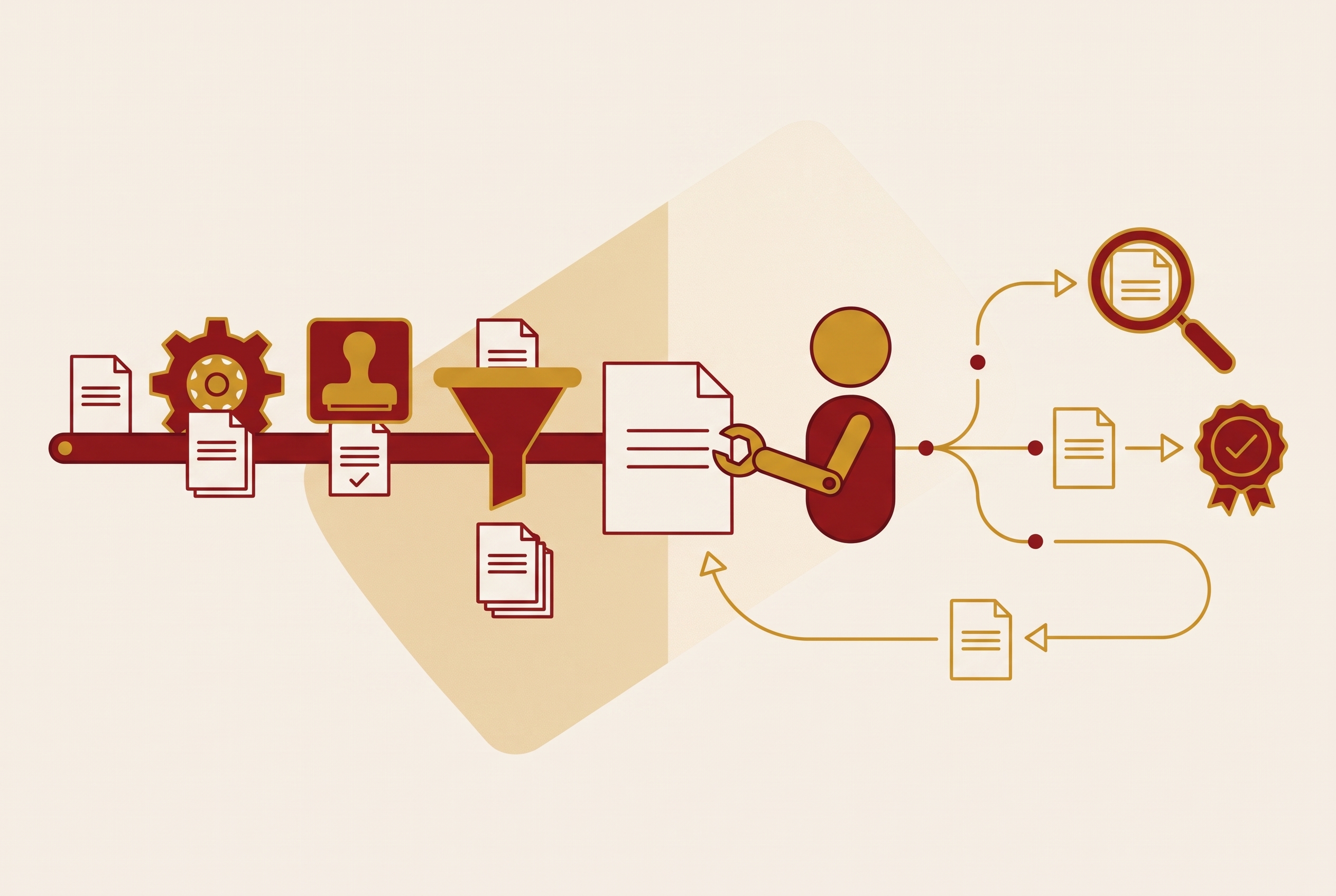
Cognitive automation and AI agents represent different architectures for legal document work. Cognitive automation follows a predefined path, while agents choose the steps to reach a goal. Each architecture supports different workflows, but delivering value with either requires operational readiness and measurement.
Why cognitive automation and AI agents are architecturally different, not just functionally different
Cognitive automation encodes a sequence before the work begins. Rules-based RPA, scripted extraction and structured routing specify what should happen when a document arrives, including which steps follow and in what order. The system executes that path. Its defining property is determinism by design.
An AI agent instead works toward a goal and chooses actions along the way. In legal work, those actions can include reviewing a contract, flagging clauses against a playbook, drafting redline comments, routing the document to a specialist and updating the CLM record. A human does not initiate every step. The distinction is therefore not whether a system can extract a clause or draft a comment, but how it decides what happens next.
This is more than a spectrum of automation sophistication. Adding rules can make a scripted workflow more complex, but who sets its path stays the same. An agent makes that choice during execution, which introduces different requirements for testing and accountability. The failure modes are categorically different. A predefined path reaches its limit when an input falls outside its rules, while a goal-directed system can take the wrong action or give an unreliable answer as it works toward its goal.
Where cognitive automation breaks down in legal document workflows
Cognitive automation suits legal tasks with a predictable structure because the inputs and the actions needed can be set out in advance. Document variability weakens that fit. Clause ordering, non-standard language, negotiated carve-outs and jurisdiction-specific requirements all create departures from the expected path. A rule that works for a familiar document may not cover a differently negotiated version. The range of documents the rule must govern can be a problem regardless of the quality of the rule.
Each exception then requires a human handoff or a new rule. The system cannot decide how to handle an unfamiliar input beyond the responses already encoded for it. Routing the exception out is useful, but it transfers responsibility for completion back to a person. That distinction is operationally significant. The automated part may get faster while the difficult work waits in a queue for legal judgment and coordination.
The constraint becomes more pronounced across a complete document workflow. Intake, classification, extraction, playbook application, redlining, CLM updates and routing cannot be treated as one fixed sequence when a diverse document population demands different responses. Context must also pass between those steps. Cognitive automation can handle the easier portion while leaving people with the exceptions, which are often the most time-consuming work. What it cannot provide in that setting is end-to-end execution across a variable document population.
What agentic workflows actually look like in production legal environments
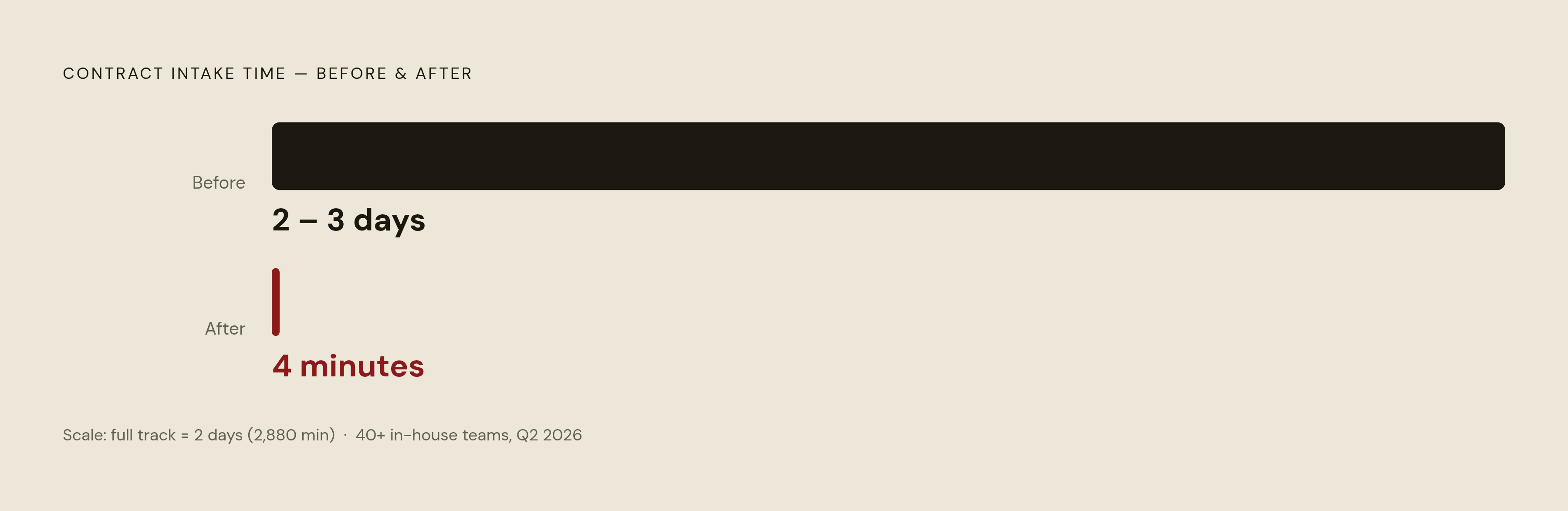
Contract intake makes the architectural difference tangible. As of Q2 2026, contract intake agents were deployed by over forty in-house teams, receiving contracts, classifying their type, extracting commercial terms, applying a standard playbook, generating preliminary redlines and routing the work with a coverage summary. Average time from receipt to the lawyer’s desk was 4 minutes, compared with 2–3 days previously. The agent prepares a package for legal review rather than completing an isolated task and waiting for someone to start the next one.
Regulatory monitoring agents continuously scan publications across jurisdictions, classify relevant updates, assess their impact and generate briefing summaries for review. Matter status reporting agents aggregate status information and push plain-language updates to client portals. Due diligence agents work through data room documents and pull out key terms and representations. These deployments establish that agentic legal work is a production architecture, although the scope of responsibility differs by workflow.
Thomson Reuters’ next-generation CoCounsel Legal, released in August 2026, shows how the planning and execution model works within a legal platform. It plans, selects tools, retrieves authority from Westlaw and Practical Law and executes multi-step workflows from a single natural-language request. LexisNexis’s next-generation Lexis+ with Protégé uses four specialized agents through its Protégé General AI mode. An orchestrator, legal-research agent, web-search agent and Customer Document Research Agent collaborate on complex workflows.
Legora extends that approach across a legal technology stack. Its custom workflow agents are tailored to practice areas, with workflows spanning Outlook intake, iManage research and Word drafting. The platform acquired Walter AI to expand its agentic capabilities, and the combined platform focuses on end-to-end matter management. A lawyer remains accountable throughout. Workflow ownership by an agent therefore describes responsibility for advancing the work.
An AI agent instead works toward a goal and chooses actions along the way.
Why most legal teams are still stuck between these two approaches
A majority of enterprises have experimented with AI agents, but fewer than a tenth have scaled them to deliver measurable value. Governance gaps, integration complexity and the absence of a clear path from prototype to production explain that divide. The obstacle is organizational as well as technical. A working agent cannot by itself supply the infrastructure required to operate responsibly.
The document systems, CLM platforms and matter management tools already in use may not be set up to pass state between agent steps. Without that link, multi-step execution can hit limits that a demonstration may not reveal. Governance adds a separate question about who is accountable when an agent makes a routing decision. Every production deployment found in 2026 has a clearly defined human review gate and escalation trigger.
Non-deterministic output adds to the difficulty because an agent can behave differently on the same input. This is repeatedly identified as the hardest production-readiness problem, challenging the testing and accountability assumptions used for other enterprise systems. Fast pilots do not remove that burden. In regulated environments, skipping audit logging and access controls has led to rebuilding when compliance flags the deployment, delaying production by four to six months. Meanwhile, teams that report time saved without linking performance to P&L outcomes have a hard time defending the investment even when the prototype works.
The hallucination and accuracy problem specific to legal agent outputs
Stanford research found meaningful error rates for Lexis+ AI and Westlaw AI-Assisted Research on legal authority tasks. Those findings demonstrate the risk of relying on generated legal answers without verification. Over 700 court cases worldwide now involve AI hallucinations, with sanctions ranging from warnings to monetary penalties. The professional consequences are concrete and enforceable. An apparently complete work product is not necessarily an accurate one.
ABA Formal Opinion 512, issued in July 2024, requires lawyers to have a “reasonable understanding” of AI capabilities and limitations. Dozens of federal and state judges have also issued standing orders requiring AI disclosure and verification. These obligations place review within professional practice. Automation does not displace that duty. The workflow needs to provide qualified review before an output reaches a client or filing.
The governance response is to design the review gate around that exposure. An agent can prepare work for a lawyer’s judgment without having the authority to make that judgment, and escalation sets out what to do when the work needs more attention. Sending output straight to a client or filing without qualified review is a failure of governance. It exposes an underlying accuracy risk.
Scripted extraction can silently return a wrong answer when a clause departs from the expected structure. Its execution is predictable. Agent failures tend to be more visible and therefore more correctable, while scripted errors can remain quiet.
What a legal team needs in place before deploying agents rather than cognitive automation
Assessing readiness for a consequential architectural change calls for an AI Operations Audit. This is a structured assessment comparable to due diligence before a significant system implementation. It evaluates current process maturity, data environment quality, integration architecture, governance and security posture, and baseline metrics for ROI measurement. A capable platform cannot compensate for an undefined process or inaccessible documents.
Production agent deployments require row-level security enforcement, credential encryption, audit logging of every query and action, and confirmed data residency requirements. These are architectural non-negotiables even during a pilot. Data readiness is equally fundamental. A majority of enterprise executives identify the lack of unified, accessible data as a challenge to agentic AI adoption. An agent cannot execute a connected workflow if the document environment remains fragmented across incompatible systems.
Only a small fraction of companies have a mature governance model for agents, and most lack visibility into which agents communicate with one another. More than half of all agents run without security oversight or logging. That gap limits accountable deployment. The audit therefore needs to establish whether the organization can govern agent activity.
Gartner warns that vendors are rebranding chatbots, RPA scripts and assistants as agents without genuine agentic capability. This “agent washing” makes architectural assessment part of purchasing due diligence. A legal team needs to distinguish a system that chooses steps toward an outcome from one that executes a relabeled script. Otherwise, it can buy the wrong architecture and attribute the resulting limits to agents generally. Pre-deployment baselines complete the assessment because, without them, even a sound implementation lacks a defensible basis for its business case.
How to measure whether the architecture you chose is actually working
Time saved is an operational measure. Reporting it as ROI leaves a gap between a faster task and the financial case presented to a CFO or general counsel. The measurement method must begin before the pilot. A baseline for the current process allows the AI-assisted workflow to be assessed against business and risk measures, connecting matter-level cycle time to revenue and cost where the relationship can be demonstrated.
Process cycle time reduction and error rate improvement provide the first two measures. Cycle time compares the complete process with its documented prior state, as in contract intake moving from days to minutes. Error measurement examines the quality of the work, including redline accuracy and missed clauses. Speed alone is insufficient evidence. A faster handoff does not establish that the legal work reaching the reviewer is more reliable.
Capacity freed versus headcount reallocated provides the third measure. Harvard Law’s finding that none of the AmLaw 100 anticipate attorney headcount reductions makes tracking where released capacity goes relevant. It tracks whether that capacity goes to higher-value work. Decision cycle time at the management layer provides the fourth measure, distinguishing faster document processing from faster management decisions. Both require pre-deployment baselines.
Revenue-adjacent outcomes are the fifth measure, including faster contracting cycles that help deals close sooner and less spending on outside counsel for commodity document review. These connect workflow performance to the business case. The organizations generating strong ROI from production agents are the minority that deployed with proper scoping, pre-deployment baselines and governance infrastructure. Measurement discipline separates that group from the larger population still reporting inconclusive pilots.
Sources
- Ten AI Predictions for 2026: What Leading Analysts Say Legal Teams Should Expect
Supplied analyst context on 2026 legal AI trends, including agent adoption, governance gaps and the 'agent washing' warning discussed in the article.