Contract Review AI Deployment Beyond Pilot Stage
The architecture that turns contract review AI from pilot into production dependency.

Contract review AI has reached majority adoption because a workable deployment architecture has emerged. Moving beyond the pilot stage depends on scoping work to retrieval and comparison, designing human review into the pipeline, and measuring business outcomes against a baseline. This article maps that architecture and the preparation that turns a promising demonstration into a production dependency.
Why contract review became the first enterprise legal workflow to cross from pilot to production
Contract review has a different anatomy from legal work built around judgment. Much of its workload involves locating provisions, comparing them with approved positions, and summarizing differences across documents. Language models can perform that work when grounded in the actual contracts. A system can identify a departure from an approved indemnity position without deciding whether the business should accept it.
That boundary makes a high-volume workflow tractable. A mid-size enterprise signs hundreds to thousands of contracts a year, reviews them under pressure from sales or procurement, and re-papers portfolios when regulations change. Production-ready uses include clause extraction, playbook-based deviation checks, first-pass redlines, obligation tracking, and due diligence triage, with human verification in each. People remain responsible for interpretation, risk acceptance, strategy, and outputs filed at court. Buyers therefore need an architecture that keeps this division of labor in place under real workloads.
What the four-stage production pipeline actually looks like
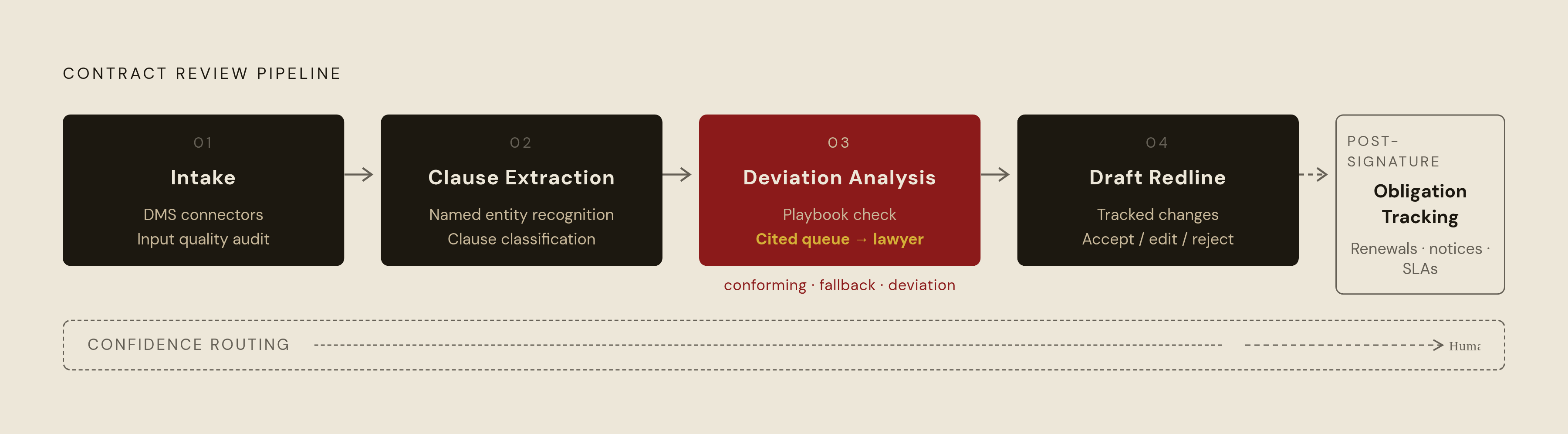
The production pipeline has four stages, beginning with intake. Documents enter through ingestion and privilege-scoped document management system connectors, while an input quality audit establishes whether they are suitable for extraction. Human review begins with that quality and access assessment. Clean digital documents support strong extraction, while scanned legacy paper produces meaningfully weaker results. Input condition is therefore a deployment constraint to assess early.
Clause extraction comes next and uses named entity recognition and clause classification to turn the text into structured output. Every extracted value needs a citation identifying the document, page, and quoted sentence, so a reviewer can reach the source text in under a second. Verification should not require rereading the entire contract. Deviation analysis then checks clauses against the playbook and classifies them as conforming, fallback-acceptable, or deviation. Its deliverable is a short, cited queue of clauses requiring a lawyer, rather than an undifferentiated stack of “reviewed” contracts.
Draft redline is the fourth stage. The system proposes edits as tracked changes in Microsoft Word, and a lawyer accepts, edits, or rejects each suggestion rather than allowing machine redlines to go automatically to counterparties. After signature, obligation tracking extends the workflow to dated commitments, renewal windows, notice triggers, and SLA thresholds. Confidence-based routing connects the stages, allowing high-confidence extractions to proceed while escalating uncertain or red-flagged clauses. This routing mechanism makes human oversight part of the workflow itself.
Why human-in-the-loop must be designed in from the first sprint, not added after a near-miss
Human oversight makes the output defensible and the process improvable. Source verification supports extraction, legal assessment resolves deviations, and approval controls the redline that leaves the team. Those roles must exist before the system handles consequential work. Otherwise, a pilot can demonstrate drafting speed without establishing who is responsible for the result. Retrofitting oversight after a near-miss adds redesign to the original deployment effort.
Professional responsibility does not move to the agent. A lawyer signs the work, a partner remains accountable for advice, and an associate reviewing an NDA still owes a duty of competence. ABA Formal Opinion 512 requires lawyers to reasonably understand the capabilities and limitations of the AI tools they use, making that understanding a procurement concern. A RACI must therefore assign a named human reviewer to every privileged output, client-facing artifact, and filing-bound document. The agent is staff, while the lawyer is principal.
The routing threshold also requires deliberate calibration. Excessive escalation consumes the review capacity the system was intended to release, while near-zero human review increases false-approval risk. Default settings cannot settle that trade-off for a legal department. Legal, HR, risk, and compliance teams frequently form the most organized internal opposition to deployment precisely because these responsibilities affect their work. Involving them in RACI design before deployment turns the readiness assessment into a shared operating decision.
What a pre-deployment audit must establish before a pilot becomes a production dependency
A readiness audit gives those stakeholders a set of conditions to check. For contract review, the most time-sensitive condition is playbook documentation, including standard positions, acceptable deviations, and escalation triggers. These are the rules against which comparison becomes useful. Organizations that already have them can deploy in weeks, while those creating them from scratch need substantially longer. Choosing a vendor does not take the place of that in-house legal work.
The audit must also establish business value through a named baseline metric and assess document quality, privilege scoping, permissions, governance, and security. Integration with the existing document management system belongs in the same assessment. So does an evaluation method with a test set for accuracy and failure handling. The audit also needs to name a business owner, spell out the human escalation path, and set out what the system will cost to run. Together, these conditions distinguish a functioning demonstration from a workflow the organization can depend on.
Document remediation deserves particular attention before commitments are made. Discovering poor scans mid-deployment extends timelines and erodes stakeholder confidence, while an early quality audit exposes that work before it disrupts delivery. Measurement needs the same early treatment. Organizations that continuously track ROI and move resources away from underperforming initiatives report substantially better AI initiative success rates. The audit establishes the baseline needed to make that governance gate useful.
People remain responsible for interpretation, risk acceptance, strategy, and outputs filed at court.
How deployment timeline and platform tier interact — and what drives realistic expectations
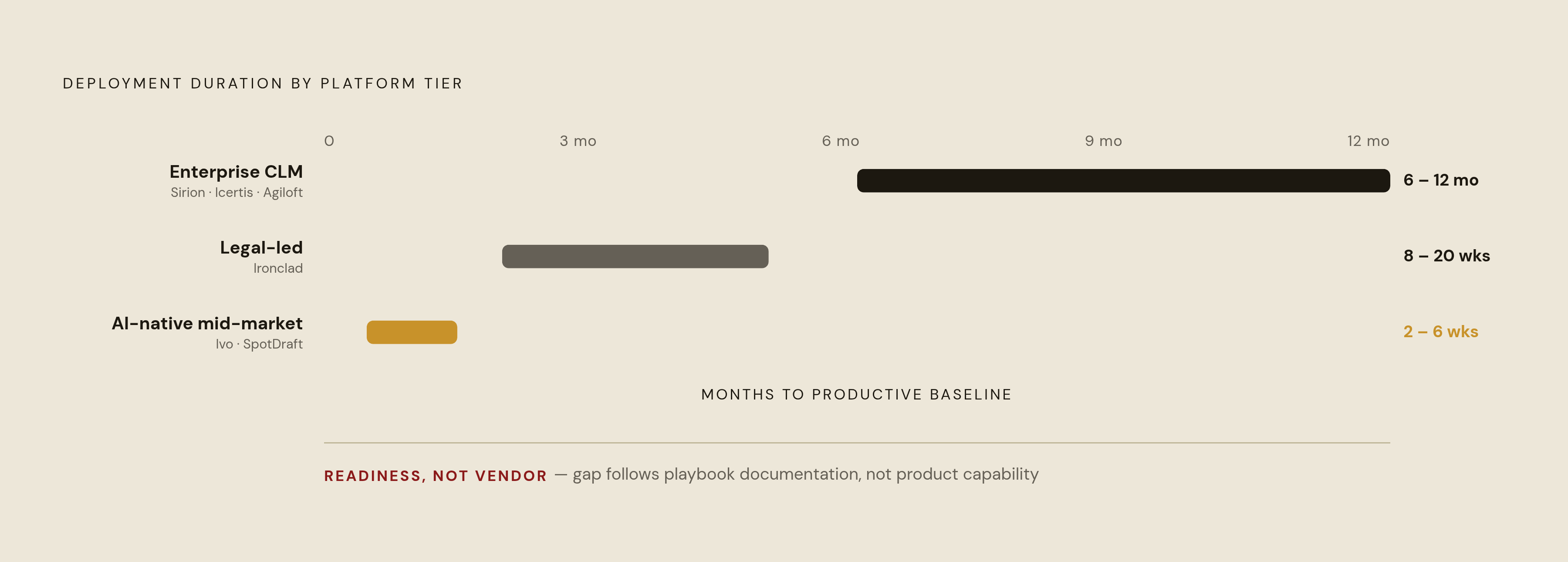
Deployment time follows organizational readiness and integration complexity more closely than vendor choice alone. Sirion, Icertis, and Agiloft typically require months for full enterprise CLM deployment, often 6–12 months. Ironclad’s typical legal-led deployments run 8–20 weeks. These platforms fit requirements such as deep workflow integration, custom position logic, or multilingual contract portfolios at scale. Their timelines reflect a broader implementation task than enabling an isolated review feature.
Mid-market AI-native platforms such as Ivo and SpotDraft can reach a productive baseline in weeks for standard playbooks and standard paper. That qualification is decisive for setting expectations. A team still defining acceptable deviations is not in the same starting position as one bringing an approved playbook to implementation. Comparing vendor timelines without accounting for that difference confuses product capability with customer readiness.
Off-the-shelf tools fit standard positions and documents, while custom agent deployments are worth the cost when positions are unusual, document quality varies, or review must work inside systems a CLM platform does not reach. Custom work is not inherently the more advanced choice. Production results are best assessed against that requirement, rather than against the breadth of features purchased.
What production deployments actually achieved — and the pattern behind the results
Standard Chartered Bank put an AI review layer in place to do the initial markup before human review, cutting its NDA review cycle from four days to four hours. The sequence is the important architectural detail. AI performs the first pass, while human review remains in place. That result fits an approach that gives more attention to work that needs legal assessment and less to provisions that are easier to review.
Wilson Sonsini used Dioptra within its Neuron platform to reduce contract review time substantially, with high accuracy on first-party contracts. The case supports a scoped review workflow. Rimini Street used agentic AI to automate multi-step review across enterprise software licensing operations, also substantially reducing cycle times. Here, sequencing was central to the result.
Icertis helped a Fortune 500 pharmaceutical company manage more than 250,000 supplier contracts in multiple languages. Outcomes included improved compliance, automated obligation tracking, optimized payment terms, and elimination of revenue leakage from untracked commitments. The financial driver was the post-signature obligation layer. Faster drafting alone would not address commitments that disappeared from view after execution.
Zycus supported a 15-hospital health system whose automated compliance checking flagged contracts missing required regulatory approvals. Category consolidation substantially reduced clinical supply vendors, with significant annual savings and improved clinical outcomes. Compliance monitoring, rather than review speed, drove this case’s value. Luminance’s use in M&A due diligence on multi-billion-dollar transactions illustrates another distinct workload, where document triage replaces intensive manual review by junior associates. Across these cases, value came from matching the pipeline stage to the actual cost driver.
How to measure and communicate the ROI of contract review AI without the traps that undermine leadership confidence
Those outcomes become an expansion case only when measurement connects them to business performance. Several hundred attorney hours saved is an operational result. Financial assessment connects what those hours cost, what they are now spent on, and what changed for the business. BCG’s 2026 Applied AI Index found that companies tracking AI outcomes directly in the P&L realize significantly more AI value than companies that do not formally measure it. Measurement discipline is therefore part of deployment performance.
For practitioners, the reporting framework should cover four categories. Business outcomes include revenue, cost, and error-rate improvements against the pre-deployment baseline, while operational outcomes include processing time, throughput, and reduced manual effort. Risk and governance outcomes cover compliance incidents, audit results, and model drift events. Adoption outcomes include user adoption, workflow integration depth, and employee confidence. This framework distinguishes a workflow earning expansion from a tool that is merely being tolerated.
Contract review offers unusually concrete measurement inputs. Attorney hours, blended rates, and contract volumes can be compared with reduced review time, cycle compression, and compliance incidents caught. Headcount should not dominate that account. Although headcount reduction was the largest outcome in a significant share of studied deployments, hiring avoided, redeployment, and no reduction together accounted for the majority. Presenting workforce reduction as the primary benefit narrows stakeholder support and misrepresents the range of outcomes.
A deployment can show faster processing without yet demonstrating lower costs, stronger compliance, or useful redeployment of legal capacity. Keeping those categories separate prevents an operational gain from being presented as a realized financial return. It also makes underperformance visible enough to address. The governance gate can then use those results to justify continued investment.
What it actually takes to cross the pilot-to-production line — and what keeps most deployments stuck
The production gap persists despite the availability of capable agents. A substantial share of enterprise AI teams have deployed at least one agent, but only a minority have moved a significant share of pilots into production. The recurring obstacles are structural. Poor data, unresolved governance, absent playbooks, undefined escalation paths, and missing baselines can all remain hidden during a successful demonstration. Each is harder to ignore once the system has to handle day-to-day work.
A team deciding whether to go ahead should start with retrieval-and-comparison tasks before taking on judgment-adjacent work. Human touchpoints belong in the design before the first sprint, while the input audit and playbook documentation belong before vendor selection. Before go-live, the team must have a named owner, a baseline metric, and an escalation path. Legal, compliance, and risk stakeholders should be RACI co-owners. Outcomes should then be reported as business and operational results.
An AI Operations Audit provides a structured way to complete that preparation. Covering data infrastructure, workflow integration, governance posture, and the ROI baseline, it establishes deployment constraints before vendor conversations become contractual commitments. The resulting systems need not look dramatic. They can be extraction pipelines with review queues, cited playbook checks, and redline suggestions that lawyers accept or reject. Technology enables contract review AI, but crossing the pilot-to-production line requires the right architecture.