Client Billing Transparency When AI Handles Legal Work
A written framework links AI pricing, disclosure, and invoice proof.

When AI executes legal work, billing transparency becomes a set of decisions about price, disclosure, and proof. Firms need a consistent way to explain what AI did, what the lawyer did, and what the client is paying for. A written framework connecting engagement terms, invoices, and confidentiality safeguards protects the firm ethically while making its value clearer to clients.
Why AI-executed legal work breaks the billing assumptions firms have always made
A partner faces a timesheet after AI has drafted a motion. The work is ready for legal review, but the familiar estimate for drafting no longer describes what happened. An hourly invoice makes a claim about labor, and a task completed largely by AI cannot support the same claim as a task performed manually.
The billable hour prices inputs. AI compresses the time required while leaving the motion, contract, or brief unchanged or improved. A contract review that formerly took several hours may now take a fraction of that time, separating the value delivered from the labor needed to deliver it. That separation exposes the model’s central limitation. A firm seeking payment for the output’s value must make a pricing decision rather than conceal that value inside hours not worked.
Client silence does not resolve the tension. Only 9% of firm leaders report hearing from clients that they expect lower bills due to AI, per the 2026 data. A large majority of corporate legal executives hold that expectation but have not yet stated it explicitly to outside counsel. The collision is deferred, leaving firms to decide whether their billing practices will explain the efficiency before clients demand an explanation.
What the ethics rules have settled, and where they leave firms with real choices
ABA Formal Opinion 512 requires hourly charges to match the time actually spent, and later state opinions follow the same rule. The opinion also treats learning an AI tool for regular client use as overhead, with a narrow exception when a client explicitly requests a specific tool the lawyer does not know how to use. Efficiency therefore changes billable time without making ordinary training a compensating charge.
Oregon Formal Opinion 2025-205 addresses a separate boundary around tool costs. Lawyers unable to determine the actual AI cost attributable to a particular representation may not prorate periodic charges and must treat them as overhead. Indeterminacy is the controlling issue in that guidance. ABA Opinion 512 also rejects boilerplate as sufficient for informed consent, while California’s 2026 guidance requires clear communication about fee calculations and how generative AI factors into rates.
Virginia LEO 1901, approved by the Supreme Court of Virginia, holds that charging the same non-hourly fee for AI-assisted and manual work is not per se unreasonable and recognizes that effective AI use may increase the skill factor. California’s guidance removed its 2023 flat prohibition and expressly contemplates flat fees that account for AI efficiency. The ABA, however, warns that a fee can become unreasonable when AI drastically reduces effort without a corresponding adjustment. A multijurisdictional firm must therefore assess its flat-fee approach under the applicable rules rather than assume that one jurisdiction’s position applies everywhere.
Three billing models firms are using, and what each one commits the firm to disclosing
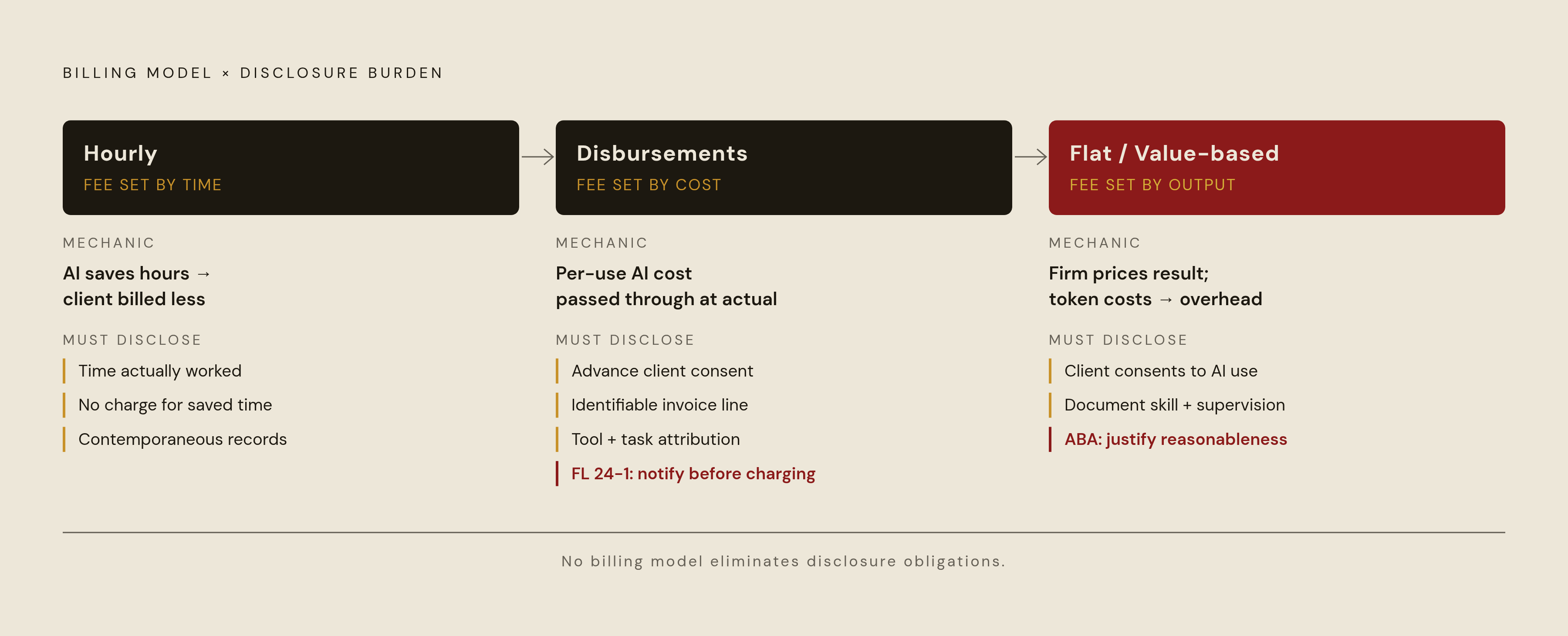
When a firm bills by the hour, the client gains from AI efficiency through fewer billed hours. Its engagement terms should explain that charges are based on time actually worked, with no charge for time saved against pre-AI task estimates. Contemporaneous tracking supplies the necessary evidence for those charges. Separately identifying AI-assisted tasks within the time record also distinguishes automated drafting from the lawyer’s review, making the allocation of work defensible in a dispute.
A firm choosing to pass through AI costs as disbursements adopts a narrower cost-recovery model. This approach uses genuinely per-use charges attributable to a specific representation. Florida Opinion 24-1 requires client notification before charging for AI usage, and Oregon’s guidance reinforces clear disclosure of AI-related costs. Advance client consent, actual cost without markup, and an identifiable invoice line define the model’s disclosure burden. Cost recovery does not capture the value AI creates.
A firm choosing flat or value-based fees instead prices the output and absorbs token costs into its economics as overhead. The client must agree to the fee knowing that AI participates in execution, with the agreement explaining how AI factors into rates. Virginia’s opinion supports this approach, but firms using it elsewhere should clearly record the skill and supervision involved because of the ABA’s warning about reasonableness. The choice changes what the firm must explain. A written policy specifying when each model applies provides a defensible pricing framework for decisions otherwise made by default.
What goes in the engagement letter before AI touches the matter
The engagement letter turns a pricing choice into terms the client can understand before work begins. Its AI disclosure should describe the tool’s role in the particular representation, including drafting, review, routing, or research as applicable. General permission is not an adequate substitute.
The fee paragraph should connect that description to the calculation of charges. For hourly work, it should explain how AI affects task time, while a flat-fee agreement should explain how AI factors into the rate. For any direct AI costs, the letter must make clear which are disbursements and which are overhead, and the client must consent before a charge appears. Billing narratives also need attention in the disclosure. The letter’s confidentiality terms should cover how the firm handles client information in those narratives as well as in case files.
Florida’s opinion recommends informed consent before confidential information enters third-party AI tools, placing that discussion at intake. A brief, plain-language paragraph addressing use, billing, and supervision is more defensible than technical language that clients do not read and lawyers do not update. The supervision terms should identify who reviews AI output and at what stage, making clear that a lawyer remains responsible for the work product.
AI compresses the time required while leaving the motion, contract, or brief unchanged or improved.
How to document AI involvement on the invoice itself
The invoice shows whether the lawyer supervised the work as promised. An entry that says only that a document was drafted leaves unclear which work was AI production and which was attorney review, revision, or verification. That distinction should be visible at task level. Where AI produced the initial document, a separate entry for the attorney’s review and verification describes the human labor for which an hourly charge is made.
A well-documented entry therefore identifies the AI-assisted task, states the lawyer’s contribution, and records the time actually spent on that contribution. Consistent notation makes the record easier to audit. The same format across a representation allows the firm to examine AI-assisted tasks without reconstructing each lawyer’s description during a dispute. Where a per-use AI charge appears as a disbursement, its line item should identify the tool, task, and actual cost without markup.
Contemporaneous records give those descriptions evidentiary force. Without them, the firm must rely on memory to explain how billed hours relate to actual work, a weak basis for an ethics review. In-house legal departments increasingly set expectations for AI use and reporting, and the bill is their recurring point of visibility. A standard invoice format can meet that expectation without waiting for each client to request a separate explanation.
Confidentiality obligations that attach specifically to billing data when AI processes it
Billing narratives can reveal a chronology of private circumstances in family law, healthcare, or employment work. The descriptions and the amounts contain sensitive content. Rule 1.6 and equivalent state rules protect information “relating to the representation” according to its content, regardless of the system holding it. Billing software is therefore not outside the confidentiality boundary that applies to case files.
The practical gap is uneven vendor diligence. A firm may scrutinize a case-management tool while overlooking an AI service that processes equally revealing billing entries. Firms should apply the same diligence to both, covering storage terms, use of narrative content, training on client data, and contractual security commitments. A lack of reported discipline offers little reassurance. Unlike a hallucinated citation, a billing-data disclosure need not produce an adversary positioned to expose it.
California Lawyers Association Formal Opinion No. 2022-1 adds a specific limit for fee collection. It prohibits using or disclosing confidential client financial or asset information to collect a judgment for unpaid fees. Evidence Code section 958 may allow disclosure that is reasonably needed to establish the fee claim, but that exception does not cover post-judgment collection. An AI billing or collection tool accessing narratives beyond what is needed to verify the fee amount may therefore exceed that limit.
Building an internal policy that makes these decisions repeatable rather than matter-by-matter
A written policy joins pricing, disclosure, recordkeeping, and confidentiality into one operating standard. It should specify which billing models the firm uses and when each applies. Standard engagement language needs review against each jurisdiction’s rules. That standardization must preserve the representation-specific explanation needed for informed consent.
The policy should also define how lawyers record AI-assisted tasks, including consistent notation and the required description of supervision. Vendor diligence should cover tools touching billing data, case files, or client communications. Disputed charges need an assigned escalation path. The policy should identify who reviews the question, which records support the review, and how the firm frames its response to the client. These provisions make the explanation traceable to established terms and contemporaneous records.
Smaller firms must meet the same ethics obligations, even though they are less likely to have formal governance or to use production AI. An AI operations audit of billing and workflows can expose missing rollback protocols, undocumented vendor terms, and absent engagement language before a complaint does. The resulting documented practice also answers in-house counsel who increasingly include AI transparency expectations in panel reviews and RFPs, where a repeatable process is more credible than a verbal assurance.
How transparency about AI becomes a client relationship asset rather than a cost center
Client procurement is moving toward explicit scrutiny of AI economics. With 61 percent of in-house legal teams planning to push for AI-related pricing changes, firms face a growing need to explain how the time saved affects the fee. Clients are also developing benchmarks for AI-enabled work. Clear disclosures and records give them a basis for evaluating the firm’s price.
The letter explains the expected use and pricing of AI, while the invoice shows what AI did and what attorney supervision involved. Efficiency can then become visible as client value. If AI dramatically reduced task time and the firm billed only actual work, the invoice can note that effect without obscuring the lawyer’s responsibility for quality.
Firms that have updated pricing and documentation hold an advantage while much of the market has not yet moved. That window is narrowing as panel reviews and RFPs standardize expectations. Pressure to lower prices takes longest to reach bet-the-company work, while routine and mid-complexity work is already moving toward flat fees and subscriptions. Systematic transparency prepares a firm for that change. Its established process lets it discuss price, supervision, and results on terms clients can evaluate, making AI efficiency a credible part of the relationship.
Sources
- AI and Attorney Ethics Rules: 50-State Survey
Supplied the state-by-state guidance on AI billing, disclosure, and confidentiality, such as the Florida, Oregon, and Virginia opinions.
- AI Amplifies Ethics Risks Across Every Billing Fee Model
Informed the analysis of how ethics risks differ across hourly, disbursement, and flat-fee models, including the reasonableness warning.