Workflow Automation ROI in Legal Operations Departments
Start with high-volume, rules-based work like NDAs and intake.

Workflow automation ROI in legal operations concentrates in high-volume, rules-governed work. The fastest returns come from choosing a narrow process, measuring its current cost, and resolving governance requirements before deployment.
Why legal ops automation ROI is concentrated, not evenly spread
Legal operations leaders face rising request volume, constrained headcount, and board-level scrutiny of legal spend. When hiring cannot keep up with demand, automation is the way to increase throughput without adding staff. Yet the pressure to automate does not make every process a sound investment. The payoff depends on the work selected. The payoff from a repeated request with settled rules differs from that of a task that needs fresh legal judgment at every step.
US Tech Automations’ 2026 guide identifies recovered attorney time as a distinctive multiplier because administrative time can become billable or strategic capacity. The benefit includes reducing the cost of processing a request and releasing lawyers for work that requires their expertise. However, that capacity must be recovered from a process frequent and consistent enough to justify the investment.
What makes a workflow an automation candidate with fast payback
A strong candidate runs often, follows a recurring pattern, and has decision rules the legal team can write down. If a lawyer must reconsider the substance of every request, automation has less routine work to remove. Conversely, a standard process with defined exceptions gives automation a clear boundary and preserves legal review where it is needed.
Low volume can defeat an otherwise suitable proposal because setup and configuration cost may exceed the time recovered from a process that runs only a handful of times per year. Inconsistent practice creates a different problem. If three lawyers handle the same request three different ways, the lesson is to standardize first and automate second. Otherwise, configuration locks disagreement into the process. A fast deployment of an unsettled workflow is not a fast route to payback.
Ownership and timing complete the screening test. Someone must be accountable for maintaining the workflow after launch, or its rules and templates can become stale. The process also needs enough stability to repay the setup effort. A pending reorganization or policy change can make that effort premature. These conditions distinguish a promising demonstration from a process ready for sustained use.
The workflows that pay back fastest, ranked by the evidence
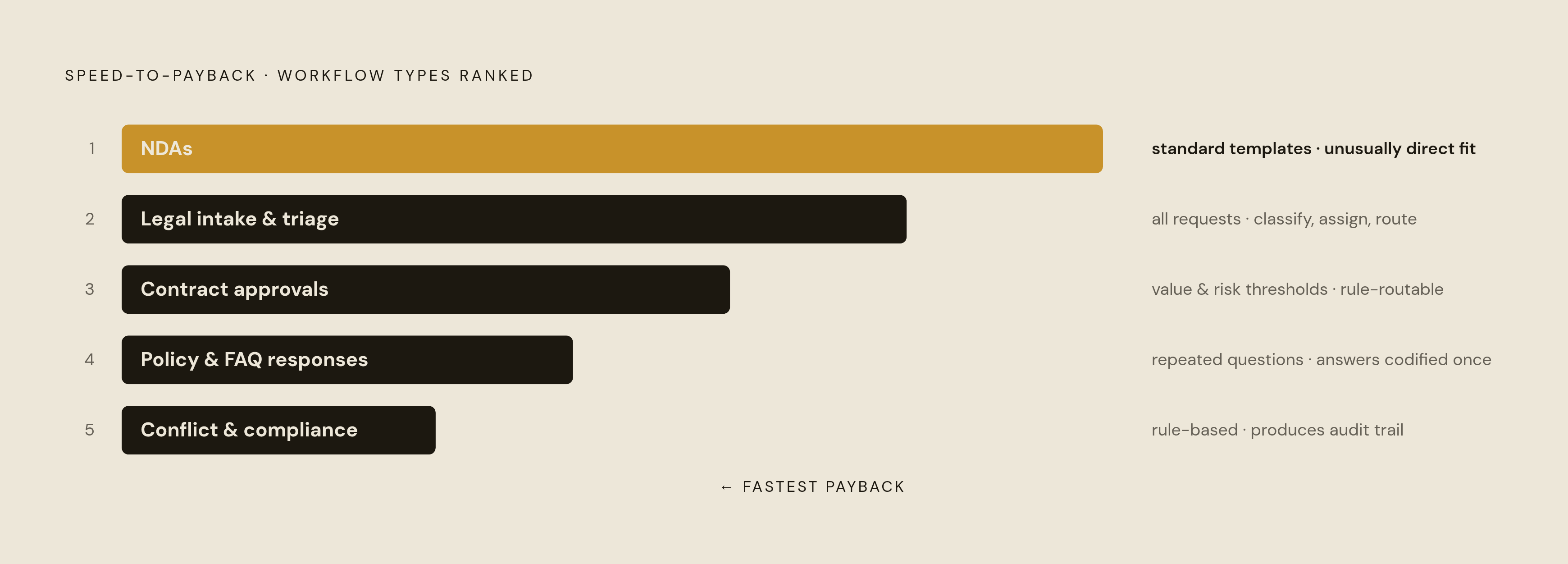
NDAs are the clearest first target because they combine standard templates, clear fallback positions, and high volume. The fit is unusually direct. Routine requests can follow settled positions while exceptions still receive legal attention. Prove one narrow, high-volume process before expanding to broad coverage.
Legal intake and triage rank next because every request goes through them, so making them better helps across matter types. AI can classify requests, assign urgency, and route them to the right counsel without a paralegal reading every inbound message. A single intake layer needs to cover email, Slack, and Teams rather than leave parallel channels outside the process. Otherwise, the bottleneck remains for requests that bypass the automated route.
Contract approvals follow because value and risk thresholds can make routing determinable by rule. The prerequisite is agreement on those thresholds before configuration begins. Policy and FAQ responses come next. Repeated business questions create recurring work that can be reduced once the answers are codified. Conflict and compliance checks complete the ranking because they are repetitive and rule-based, with the added benefit of an audit trail that manual processes do not provide. This order reflects speed-to-payback and clarity of fit.
How to calculate the return before committing to a deployment
The annual benefit estimate needs four inputs, namely annual volume, current time per instance, time after automation, and loaded hourly cost. Current time should include both lawyer and business time, including follow-up and back-and-forth. That work is easy to miss. It rarely appears as a separate budget line, yet it can account for a meaningful part of the process. The post-automation estimate should remain conservative because some requests will still need a lawyer.
To turn those inputs into a business case, subtract expected time after automation from current time, convert the saving into hours, and multiply by annual volume and loaded hourly cost. Where different people contribute, their time should be valued at their respective loaded costs. Loaded cost is not salary alone. The result estimates the annual value of recovered capacity, which may leave spending unchanged. A CFO needs that distinction to understand what the deployment is expected to deliver.
The return also depends on setup and ongoing maintenance costs. Payback comes when the benefits add up to cover those costs, while maintenance continues to cut into the net benefit afterward. Platform choice affects that calculation. If legal operations can update rules and templates without an IT ticket, maintenance costs remain more predictable. If a vendor or developer has to make every change, the ongoing costs add up.
US Tech Automations’ 2026 guide identifies recovered attorney time as a distinctive multiplier because administrative time can become billable or strategic capacity.
Why contract workflow automation concentrates the most documented ROI
Contract workflows have the deepest evidence base because contracts connect legal with procurement, sales, and HR. A faster agreement process can save time within legal and release work across those functions. The starting gap is often wide. Many legal teams still rely on email and shared folders, so people have to track the work and coordinate it by hand. Contract lifecycle management, or CLM, is the platform category through which those connected workflows can be automated.
Sirion’s 2026 guide documents a reduction from roughly 19 days for a manual contract cycle to a fraction of that with automation. The commercial consequence extends beyond processing speed because a contract bottleneck can prevent a deal from closing. That makes cycle time an enterprise outcome. The strongest contract business cases therefore look beyond what the legal department spends on labor.
Sirion cites Gartner’s definition of advanced contract analytics as AI techniques that pull out provisions and turn them into structured data that people can use. This changes what contracts can support after signature. With structured data, teams can carry out obligation tracking, renewal management, and enterprise reporting that manual systems cannot support. Centralized CLM also addresses the governance gap created by fragmented contract information. A single source of contract truth gives stakeholders a common basis for compliance, rather than leaving each function to work from disconnected records.
Why so many deployments stall before they reach production
Enterprise AI agent pilots are cancelled, deprioritised, or quietly shelved, and legal is not exempt from that pattern. A general-purpose tool may produce useful outputs while the surrounding workflow remains inconsistent. An audit request then exposes the missing decision trail. At that point, a promising demonstration cannot establish the defensibility needed for routine legal use.
The underlying failures are operational as well as technical. Without a written authorization policy, it is unclear which roles have the authority to activate, modify, or suspend an agentic workflow. Without observability, decisions lack an audit trail. Missing baseline metrics prevent a credible before-and-after comparison, while the absence of a dedicated business owner leaves no one accountable after deployment. These omissions can block payback even when the tool performs its immediate task.
Security and privilege concerns create another barrier that must be resolved at the architecture level. Public LLM APIs can put attorney-client privilege at risk if confidential data is used for model training. Architecture therefore belongs before deployment. Legal enterprises are moving toward private, VPC-hosted agents to keep confidential data from reaching public foundation models.
Governance review also consumes part of the speed advantage automation creates. Its cost belongs in the operating model. A workflow that does a task quickly but needs a lot of review may free up less capacity than its demonstration suggests. Unresolved controls defer decisions until the point when the deployment needs to prove its value.
What separates deployments that reach production from those that don't
These failures require pre-deployment discipline. A written authorization policy establishes which roles can activate, modify, or suspend an agentic workflow. That prevents each governance question from being reopened in real time. Mapped rollback protocols provide a documented route back to the manual process if automation fails or produces an unexpected output. Together, authority and reversibility make the workflow governable beyond its initial demonstration.
Testing must address both successful completion and failure. Stale-context failures and edge cases need to be exercised before go-live. Vendor agreements require their own review. Differentiated agentic liability terms set out who is accountable when something goes wrong, so teams need to review those terms as part of the readiness assessment.
Baseline measurement is equally necessary, but for a different reason. It establishes whether the deployment can later demonstrate a return to finance or the board. An AI Operations Audit checks these requirements together before deployment, looking at whether the workflow is ready, where governance falls short, and what baseline metrics are in place. The audit identifies blockers while they can still be addressed. That structured diagnostic compresses the route to production and supports returns measured in weeks, avoiding quarters spent in unresolved pilots.
How to measure and report ROI so finance and the board accept it
Login rates and usage statistics show interaction with software, leaving whether legal work became faster, more consistent, or less costly to be measured separately. The distinction is fundamental to investment decisions. Cycle time, error rates, and matter throughput per attorney connect measurement to the work the department must deliver. Those measures also allow results to be compared with the baseline captured before deployment.
The metrics should match the automated process. Legal touchpoints per matter show how often a lawyer still intervenes in work the workflow was intended to handle. Matter throughput per FTE shows whether fixed headcount processes more work. Missed deadlines and compliance exceptions expose the risk side of the result. These measures prevent a reduction in one visible task from standing in for a broader claim that the entire process has improved.
A board-ready case presents efficiency and risk reduction together. Time recovered, cost reduced, and throughput increased form one side, while fewer missed renewals, defensible audit trails, and consistent approval rules form the other. Neither side should disappear from the report. Capturing outcome metrics from day one makes an observed return in weeks more persuasive than a projection extending into quarters. It also gives finance a basis for distinguishing recovered capacity from realized spending reductions.
Sirion says the strongest cases link the results of contract automation to reporting across the enterprise. That framing changes the investment conversation. Legal operations can show how faster cycles, greater throughput, and less risk help with commercial work across the organization. A department that reports those outcomes builds the trust it needs to win funding for its next deployment. One that reports only logins and usage is still seen as a cost center buying software.
Sources
- AI Contract Lifecycle Management: The 2026 Survey on Trends & ROI
Supplied survey-based context on AI-enabled contract lifecycle management and its ROI, supporting the section on contract workflow automation.