Measuring AI ROI in Law Firm Operations Within 90 Days
Baseline your costs first, then track three workflows to prove returns.

Measuring AI ROI in law firm operations within 90 days is achievable, but the measurement must begin before deployment. Firms need a financial baseline, a readiness audit, and a narrow sequence of workflows whose results can be tracked. AI use must be judged by whether it produces a defensible change in the firm’s costs, capacity, or realization.
Why most law firms that deploy AI cannot tell whether it worked
Most legal teams use AI in some form, yet many cannot point to a formally measured outcome. A managing partner may know that a tool has been activated without knowing whether it changed anyone’s work, much less whether that change improved the firm’s financial results.
The missing element is a financial baseline. Without a record of what work cost, how attorneys spent their time, and how much billed value the firm realized before deployment, later results lack a reliable comparator. The firm may see that work is faster without knowing how that affects its finances. This is why deployment activity and evidence of return can diverge. A firm can accumulate users and pilots while remaining unable to distinguish a useful investment from an additional operating expense.
The three financial metrics that form a measurable baseline
Cost per matter is the first baseline, and it must be broken out by practice area. A firm-wide average can hide gains in one area that are offset by rising costs in another. The baseline therefore needs enough detail to compare the work selected for deployment with its pre-AI cost, rather than with an average drawn from unlike work across the firm.
Billable hours per attorney establishes the utilization baseline. AI can improve utilization by removing administrative tasks that consume non-billable time, but that effect is invisible without a starting measure. Time released is not automatically billable time. The comparison must show whether the change in work increased billable utilization, because each hour saved on an administrative task does not bring the same financial gain. Utilization, realization, and leverage are the core profitability measures AI can affect, so their starting positions also need to be understood before deployment.
Realization rate establishes how much billed value the firm ultimately realizes. More efficient work product can reduce client pushback and write-downs, making this a distinct measure from hours worked or recorded. The distinction is financially significant for the firm. A change in recorded hours does not, by itself, establish an improvement in realization, and the baseline must allow those movements to be examined separately. These are standard financial measures. Establishing them is the first action in the 90-day framework, before any tool is switched on.
Why an AI operations audit must come before deployment, not after
A financial baseline establishes the comparison, but it does not establish readiness. Before deployment, a firm must check whether its data, governance, and workflow architecture can support a production AI system. Readiness cannot rest on confidence alone. Firms that describe themselves as ready can fall short when asked for written authorization policies, mapped rollback protocols, or vendor contract terms that distinguish the risks of different services.
Wolters Kluwer’s legal operations AI analysis describes legal teams as underarchitected. Platforms, data, and operating discipline may already exist, but they have not been assembled into a system that supports dependable work. Another purchase does not close that gap. The audit must therefore identify candidate workflows, the data sources that feed them, who owns their outputs, and the rollback protocol if an agent acts on stale information.
For law firms, the main risk at the data layer is a loss of privilege protection. Public LLM APIs can create a significant risk of waiving attorney-client privilege when client data is transmitted to, or used for training by, a third-party provider. This is not a secondary procurement concern. The audit must verify that the proposed system keeps client data in a private, controlled environment and that its governance supports that requirement. Financial promise cannot substitute for an acceptable treatment of privileged information.
The audit’s output should be a go/no-go signal and a deployment sequence. A workflow with attractive potential savings is not ready merely because its baseline is available. The firm must also have ownership, data controls, authorization, and rollback arrangements in place. Where those conditions are missing, the audit identifies what prevents deployment. Where they are present, it gives the firm a basis for moving into measured production rather than commissioning another report that does not change how work is done.
The firm may see that work is faster without knowing how that affects its finances.
Which legal workflows to instrument first and why the order matters
The fastest route to credible early ROI is not the broadest deployment. Workflows that produce measurable results quickly share two properties, which are high volume and a definable before-and-after unit of work. Repetition makes the comparison possible within a tight window. A clear unit makes the result interpretable, because the firm can connect a change in effort or cost to a specific task.
Contract review is the starting point a firm can be most confident in. It provides a defined workflow against which the firm can track effort and cost, with contract cycle time as a clean secondary measure. Cycle time is the time from a request to an executed contract. Tracking that time needs no financial modeling, so it can show early on that the process has changed, even before the firm works out what the change is worth. It supplements the financial baseline.
Time capture and billing recovery is the second workflow to instrument because it connects directly to the realization baseline. Time-capture AI tracks what attorneys do and brings up entries for work that might otherwise go unrecorded, including quick client emails, brief research queries, and short calls. Evidence can appear within weeks of deployment. Measuring recovered entries and realization separately lets the firm see both how much more work it captures and how much value it has realized, without assuming that each added entry has already brought in value.
Legal research acceleration is a strong third candidate where volume justifies it. Associates spend a substantial share of billable time on research, and AI-powered research tools can compress that effort materially. The unit is hours recovered per research task. Multiplying those hours by the attorney’s loaded rate gives the firm a basis for valuing the capacity released. Starting with these measurable workflows concentrates the early window on work that can produce credible comparisons before a broader deployment makes attribution harder.
What to measure in each of the three phases of the 90-day window
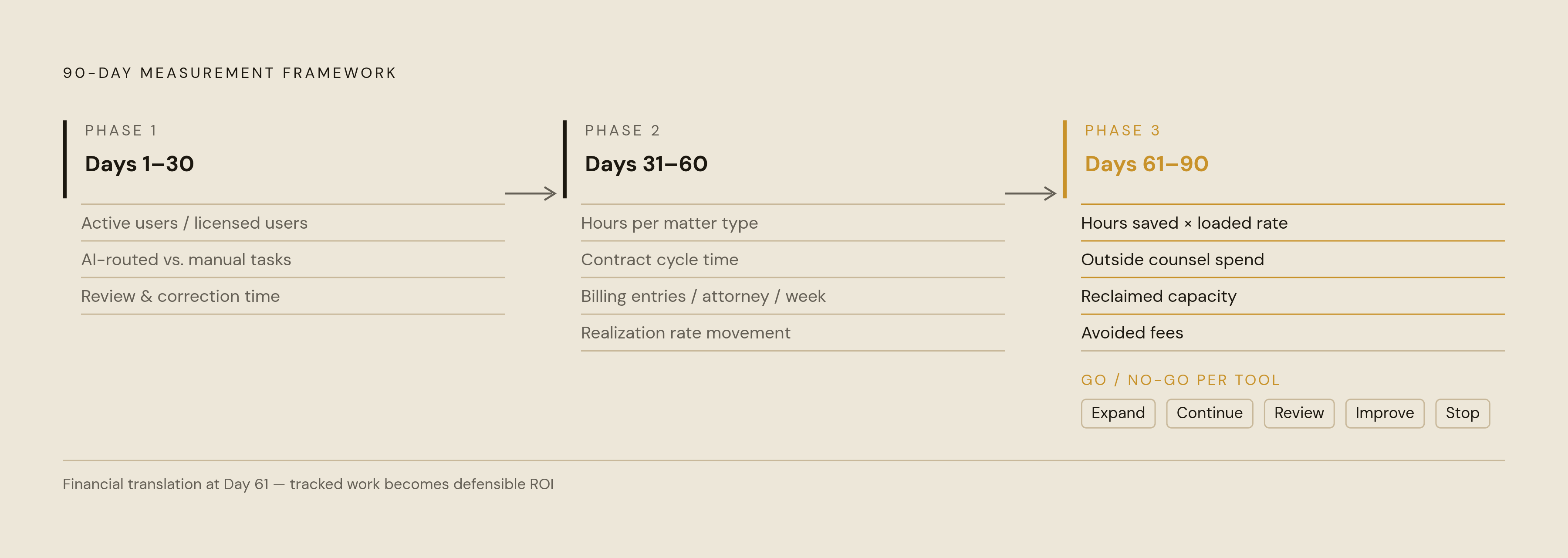
Days 1–30 establish adoption and process signal. The initial measures are active users as a share of licensed users, tasks routed through the AI system rather than handled manually, and attorney time spent reviewing and correcting outputs. A licensed or activated tool that has not become part of the workflow produces adoption data. Review and correction time belongs in the measurement from the start because it is part of the work required to use the output.
Wolters Kluwer’s framework identifies attention, rather than information, as the underlying challenge for legal teams. Usable evidence from the deployment depends on how the firm manages change during this phase. If tasks still bypass the system, low measured savings cannot tell the firm how much the workflow could save. Conversely, high user activity does not establish value when the effort required to review and correct outputs remains unmeasured.
Days 31–60 compare efficiency with the baseline. The measures are hours per matter type, contract cycle time, billing entries captured per attorney per week, and movement in realization rate. Each applies to the workflow it describes. Hours per matter and billing entries need comparison with their pre-AI starting points, while cycle time shows whether the contract process has shortened. Realization then helps establish whether improvements in work and billing are translating into a financial result.
Self-estimated time savings overstate results, whereas historical matter data and cohort comparisons provide a firmer basis for scrutiny. Reported gains need an objective point of comparison. This phase must also separate realized value from work already completed and tracked from projected value from savings expected to recur. Only the former belongs in current ROI reporting, while the latter remains an input to planning.
Days 61–90 translate measured work into financial value. The calculation multiplies hours saved by the relevant loaded rate and adds spend avoided. Its inputs must come from tracked work. The three sources are outside counsel spend addressed through consistent guideline enforcement and invoice review, reclaimed capacity from work that would otherwise require additional headcount, and avoided outside counsel or consultant fees.
By day 90, every tool in the deployment should receive a decision state of expand, continue, review, improve, or stop. The decision depends on net value and how strong the evidence is. Vendor claims and enthusiasm for a pilot cannot prove either, even when users like the experience. A tool with promising but inconclusive results needs a different decision from one with demonstrated financial value.
How to communicate the 90-day result to firm leadership in terms that hold up
Hours saved × loaded rate + spend avoided is the financial value calculation that should lead the leadership report. The platform that produced the result is secondary. The report must connect that number to the work measured and keep realized value separate from future projections. A technically correct calculation loses decision value when it is surrounded by jargon or detached from the operational evidence that supports it.
Each gain should be anchored to a workflow leadership already understands. A reduction in contract cycle time connects to revenue velocity, while better realization connects to profitability per matter. Reclaimed capacity informs a different decision about headcount. Showing how many hours AI took on that would otherwise have required more hiring lets leadership judge that benefit.
Leadership will also ask whether the gains are durable. A first-window result does not, by itself, prove that the same performance will persist. The decision states make that uncertainty explicit. Tools assigned expand status have positive net value and strong evidence, while those assigned review or improve have inconclusive data and should not be presented as proof of ROI. NetLift’s framework treats future value as a projection that depends on maintaining current efficiency gains, so it belongs on a separate line from the realized result.
The first 90-day cycle is the hardest because the financial baseline and measurement infrastructure must be built before the result can be defended. Subsequent cycles begin with that infrastructure in place. The firm can then assess additional deployments against established measures.