AI Agent Deployment Timelines in Legal vs Other Enterprise Verticals
Legal agents require attorney review and governance setup that other verticals can skip entirely.
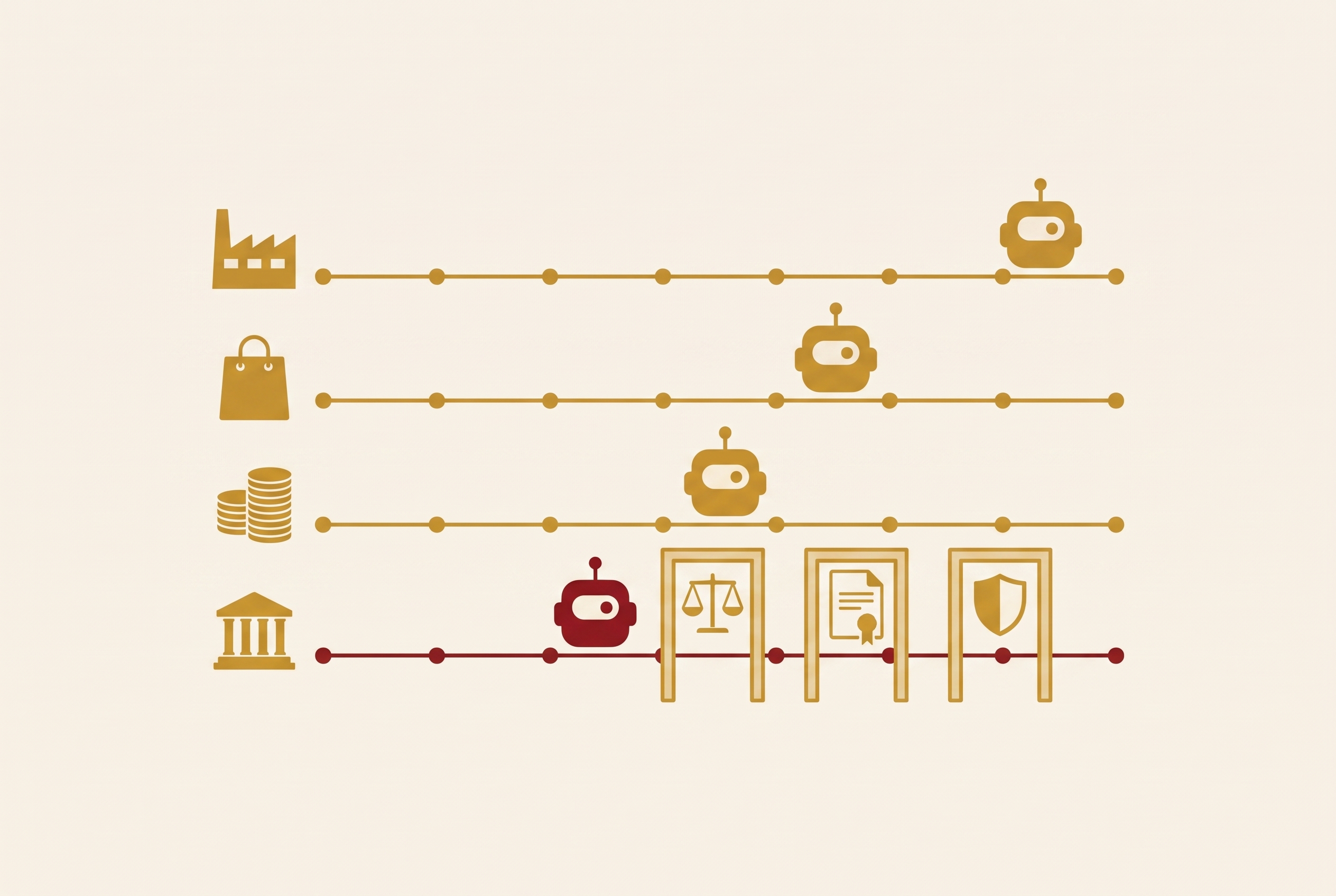
AI agent deployment timelines differ across legal, automotive, and healthcare because production readiness depends on more than model capability. In legal, governance must come first because of mandatory attorney review, unstructured documents, and professional liability. Understanding those constraints gives enterprise leaders a sounder basis for sequencing deployment, setting timelines, and measuring returns than applying one enterprise playbook to every vertical.
Why most AI agent pilots stall before reaching production — regardless of vertical
A pilot can succeed against a dedicated database view or staging API without proving that an agent can operate in production. The transition exposes a different environment, including batch-only exports, undocumented CRM fields, and VPN-gated document management. Integration becomes the first serious test of readiness. The March 2026 survey identified legacy integration complexity and unclear organizational ownership among the causes of scaling failure, with weaknesses compounding.
The same survey found that successful organizations assigned evaluation, monitoring, and incident response to a dedicated AI operations function, distinct from IT and the business unit. Diffused ownership was associated with failure to scale. Successful deployments also started with one clearly defined task rather than broad, multi-function agents that did some workflows better than others.
What the production gap actually measures — and why it reads differently by vertical
Production rates measure more than an organization’s willingness to adopt AI. The March 2026 survey placed financial services at the high end of production deployment and healthcare at the low end, with healthcare recording just 8%. Manufacturing and retail clustered near the average. Yet these rates reflect different combinations of preparation, regulation, and operational risk.
Financial services benefited from early investment in document processing and compliance automation, while healthcare faced regulatory complexity and clinical risk aversion. Legal has another constraint: an attorney must review every meaningful output. Better accuracy can reduce errors, but it cannot remove a professional review obligation, so a legal deployment plan centered on model improvement alone leaves the governance bottleneck unresolved.
Why automotive deploys AI agents faster than any other operational vertical
Automotive provides the operational baseline because defect rates, downtime, and lead conversion offer clear measures against which agent performance can be assessed. The feedback is tied to observable operations. In automotive workflows, there is no profession-wide rule that an attorney must review every meaningful agent output before anyone acts on it, as there is in legal work.
Mercedes-Benz’s agreement with Apptronik illustrates the bounded scope available in this environment. The companies are evaluating potential deployment by piloting the Apollo humanoid robot in manufacturing facilities and studying potential logistics and assembly tasks. In this defined setting, teams can judge possible uses by how well they handle physical tasks.
That distinction helps explain automotive’s faster deployment path without treating it as an absence of governance. Monitoring and output quality still require attention. However, physical measurability and clear baselines make those requirements easier to specify before expansion. An automotive team can assess an operational result directly, while a legal team must also establish who reviews the result and accepts professional responsibility for its use.
Where healthcare sits on the deployment curve and what slows it down
HIPAA Business Associate Agreement requirements rule out many off-the-shelf platforms and push deployments toward self-hosted or enterprise-grade compliant tools. Qualification precedes the evaluation of a use case. Having to do this compliance work up front helps explain healthcare’s low production rate, though the survey rate alone cannot show how long any one deployment takes.
The distinction between administrative and clinical work then shapes deployable scope. Prior authorization processing and appointment scheduling address administrative burdens without placing an agent at the center of a clinical decision. Clinical workflows expose organizations to greater liability and risk aversion.
Salesforce’s Agentforce Health illustrates where vendors see room to deploy. Its Epidemiology Analysis Agent helps detect patterns in infectious disease, while its Referrals & Assessments Agent automates the work of coordinating primary care with specialists. These are distinct forms of operational support. Their availability does not remove the need for HIPAA compliance verification, vendor qualification, and clinical escalation paths before patient-adjacent workflows enter production.
The structural reasons legal deployment timelines are longer than any other enterprise vertical
Mandatory attorney review is legal’s most distinctive constraint. No fully autonomous legal work is permitted under the professional obligations described here, so meaningful agent outputs must pass through human review. This is not simply a conservative operating preference. In automotive, an output can trigger an action, while in legal it triggers a review that can then authorize an action. Deployment must therefore accommodate the reviewer as a permanent part of the workflow.
That requirement changes what an agent’s speed can deliver. Faster drafting or research does not eliminate the interval needed for an attorney to assess the result. The review architecture must be in place before production begins. A firm that has improved generation speed but has not defined attorney responsibility and escalation is only partly ready to deploy. The non-automatable gate remains in place regardless of model capability.
How unstructured documents are read can create professional liability, while the median firm’s governance infrastructure falls well short of what deployment requires. Access alone does not establish production readiness. Firms must work through permissions, AI policy documentation, error detection, and who owns the work before they depend on an agent in production. Without those foundations, a pilot can work well on the technical side and still leave the firm with much to do.
Errors make that unfinished work consequential for individual attorneys. Stanford research found meaningful error rates in leading legal AI research tools, showing that specialized legal products do not eliminate incorrect outputs. The brief also records over 700 court cases worldwide involving AI hallucinations, with sanctions ranging from warnings to five-figure monetary penalties. Validation is therefore more than a quality-control preference. Human-in-the-loop architecture addresses exposure that can attach to the firm and personally to the attorney.
The 12-to-18-month deployment estimate provides a working frame for legal planning, with duration varying by firm. Readiness determines how much work precedes production. That distinction becomes especially important when vendor release schedules move faster than firms can establish the controls needed to use new capabilities safely.
Successful deployments also started with one clearly defined task rather than broad, multi-function agents that did some workflows better than others.
How the legal vendor landscape is accelerating ahead of firm readiness
Thomson Reuters launched agentic workflows in CoCounsel in August 2025, including autonomous document review and “Deep Research” capabilities, with further expansion to the UK in early 2026. LexisNexis’ next-generation Protégé General AI uses four specialized agents, including an orchestrator, a legal research agent, a web search agent, and a customer document research agent. These products extend beyond isolated drafting assistance. Their coordinated workflows give firms more to test, while firms still have to meet professional review requirements even when products are ready to use.
Anthropic released Claude for Legal with 20+ MCP connectors to platforms law firms already use and 12 practice-area plugins. Freshfields’ use of Claude grew sharply within the first six weeks of deployment, before that release and helping drive it. Demand can develop faster than governance readiness. Connectors and specialized capabilities expand what is technically accessible, but they do not establish whether a firm has the permissions, policies, evaluation methods, and ownership needed for production.
The Clio 2026 Legal Trends Report for Solo and Small Law Firms shows the distance between broad use and business transformation. The report found that the majority of solo practitioners and small firms use AI, yet only roughly a third report revenue growth from it, and most have made no pricing changes. Adoption alone is a limited indicator of integration. The pattern suggests that much use remains at the individual task level, such as research assistance or drafting support, rather than agents executing complete workflows with the required review architecture.
What a realistic deployment sequence looks like across legal, healthcare, and automotive
A common pilot-to-production framework can apply across sectors, but its stage durations and go/no-go criteria must differ. Governance belongs before scale. In automotive, this primarily means establishing output-quality monitoring and baselines for measures such as defect rates and lead conversion. Clear, measurable outputs allow that work to proceed relatively quickly.
Healthcare requires HIPAA compliance verification, vendor qualification, and clinical escalation paths before an agent touches patient-adjacent workflows. Those requirements take weeks or months of work up front. Legal must instead resolve professional liability, attorney-review architecture, error detection, and AI policy documentation before production. Because many firms lack that infrastructure, governance can become the longest phase.
A formal AI readiness assessment should therefore precede a commitment to a deployment timeline in high-constraint settings. Gartner predicted substantial abandonment through 2026 among AI projects unsupported by AI-ready data. MIT Project NANDA’s 2025 research found that the majority of generative AI pilots showed no measurable P&L impact, with failure concentrated in scoping and integration. An assessment identifies the actual obstacle before investment is committed to the wrong remedy.
Each proposed use case needs a named business owner, a baseline metric, a test set for accuracy and failure handling, and a defined human escalation path. An AI Operations Audit should test business value, data quality, permissions, governance, security, integration, evaluation, ownership, and ongoing operating cost before the pilot becomes a production dependency. Scope should remain narrow during initial operation. The successful deployments described in the March survey expanded only after 90-plus days of stable operation at production volume, with quality metrics within acceptable bounds. That provides an evidence-based expansion gate rather than a deadline driven by product availability.
Why ROI measurement in legal requires different baseline methodology than other verticals
Legal’s review obligations and governance requirements also change the financial test of deployment. Time saved in generating an output is not equivalent to the net benefit of a reviewed workflow. The assessment must include the work of review and the cost of getting ready. CFOs require models that address time saved, cost reduction, quality improvement, revenue impact, and risk reduction, while cost reduction alone can fail audit committee scrutiny. In legal, omitting risk reduction can exclude a primary reason for the investment.
A credible baseline requires prior trends and pre-deployment data sufficient to distinguish AI effects from seasonal variation, volume growth, or concurrent restructuring. Legal case volume and billing cycles make that isolation harder than in automotive or manufacturing. A short comparison can misstate the return.
A three-tier evidence framework allows progress to be reported without confusing readiness with realized profit. Capability ROI establishes that infrastructure and readiness now exist, while Trending ROI captures directional signals such as falling cycle time and rising adoption. Realized ROI requires confirmed, audited financial return. Across a 12-to-18-month legal deployment horizon, the first two tiers provide interim evidence without presenting it as a completed financial outcome.
The governance investment consequently contributes to the value case. Firms that invest meaningfully in AI governance report higher operating profit growth and customer satisfaction than those that treat governance only as a cost. Full integration, rather than continued piloting, is associated with capturing the greater share of AI-generated economic value. Legal’s slower timeline can support a more defensible ROI claim when managed correctly, because the governance and baseline work required for safe deployment also supplies the audit trail needed to substantiate the return.
Sources
- Agentic AI Enterprise Adoption 2026: 72% Production Proven
Provided the March 2026 survey data on production deployment rates by vertical, including healthcare's 8% rate, financial services leading, and findings on scaling failures tied to legacy integration and diffused ownership.
- Agentic AI following GenAI’s growth trajectory in legal, but with unique oversight challenges, new report shows
Provided background on agentic AI's growth trajectory in legal and the unique oversight challenges it poses, including mandatory attorney review obligations.