Legal AI Partnerships Between Firms and LegalTech Vendors
Legal AI only gains traction when embedded inside workflows lawyers already use daily.

The defining question in legal AI partnerships is no longer which features a vendor offers. It is whether the AI lives inside the workflows lawyers already use, and the market is reorganizing around that distinction. Few vendors control all the components that reliable legal AI requires. Model quality, trusted legal content, citation grounding, and workflow integration each demand distinct expertise, and a single organization rarely possesses all four. Partners can put the stack together faster than any vendor could build it alone. That structural reality explains why the character of legal AI partnerships has shifted: the announcements that matter now concern embedding, not bundling. The strategic question a firm must answer is not whether an AI can perform legal tasks. It is whether the AI appears inside the tool the lawyer has open all day.
Thomson Reuters showed this logic when it announced an MCP integration connecting Claude with CoCounsel Legal, so lawyers can move between general-purpose AI work and citation-grounded legal work across Westlaw, Practical Law, and KeyCite. The announcement carried no new standalone capability. It extended continuity between two environments a lawyer already inhabits, a workflow-continuity play rather than a feature launch. The pressure this creates on thin-layer vendors is considerable. A startup that wraps a general model in a legal interface becomes redundant the moment the model company partners directly with the workflow platform.
Firms gain traction when their vendors embed AI into complete workflows instead of bolting features onto existing tools. The market is moving the same way, away from thin-layer wrappers and toward systems that own end-to-end execution. Eigenomic, an enterprise AI agent company operating across automotive, legal, and healthcare, has demonstrated the principle by deploying production-ready agents that operate inside existing operational systems rather than alongside them, going live within weeks.
What consolidation in the legaltech market reveals about which partnerships hold
The M&A activity of early-to-mid 2026 reads at first as a conventional wave of consolidation. It is not random. It signals which forms of legal AI are defensible and which are not, and the sorting mechanism is consistent: acquirers are paying for workflow depth and data infrastructure, not for interface layers.
Legora's acquisition of Qura, announced April 23, 2026, is the clearest expression of that logic. Qura built structured legal databases for reliable AI reasoning, live in multiple jurisdictions in competition law. Legora paid for jurisdiction-depth and the underlying data infrastructure, not for a polished user interface. Thomson Reuters made a comparable bet when it completed its acquisition of Noetica in February 2026. Noetica builds AI tools that transform corporate transaction-deal data into structured market intelligence for deal professionals. That purchase extends transactional workflow depth, a defense against the commoditization of legal research itself.
LawConnect's acquisition of Finchly, also announced in February 2026, operates at a different layer but points the same direction. Finchly contributes client-matching technology and a network of more than 350 participating law firms across Australia. LawConnect bought a distribution-layer asset, evidence that consolidation is not only about AI capability but about controlling where legal work enters the system. The valuation gap that follows is structural. Companies that add a thin legal interface to a general model face compression, but platforms with genuine workflow automation and defensible data gain value either way. Workflow-embedded AI systems have taken hold this way across verticals where operational complexity means you need integrated ownership from day one, not iterative feature addition.
How the access gap between enterprise and small-firm deployments shapes partnership design
Workflow embedding applies across firm sizes, but the partnership vehicle has to meet lawyers inside tools they already use daily. That principle holds whether the tool is enterprise document management or small-firm practice management software, and it is the organizing constraint that shapes sustainable legal AI partnerships at any scale. Smokeball and Thomson Reuters announced a partnership on March 25, 2026, connecting Smokeball's practice management platform with CoCounsel Legal, including Westlaw Advantage and Practical Law Dynamic Tool Set capabilities. The intention is explicit: to bring enterprise-grade legal AI into small and mid-sized firms through their existing practice management tool. The design logic mirrors the enterprise deals, meeting the lawyer inside an application already open rather than a standalone product. The vehicle differs because small firms run their work through practice management software, not the document management ecosystems that dominate BigLaw.
The objection this raises seems at first to be about price. It is not. The deeper issue is workflow fit. Small firms and in-house teams operate different tool stacks, and a partnership that embeds well into a global firm's document management environment may be invisible to a small firm running Smokeball. Avvoka's significant funding in 2026 for high-volume contract workflow automation illustrates that the segmentation runs deeper still: contract-layer tooling for organizations with large contract volumes forms a distinct segment from legal research or litigation support. Partnership design, in other words, must resolve not only what the AI does but where it lives for a particular kind of legal organization.
What enterprise deployments by Linklaters, Ballard Spahr, and Blackstone show about production-readiness
The firms getting measurable results from legal AI partnerships share one structural property. The vendor relationship is anchored to end-to-end workflow ownership, meaning ongoing operational responsibility for a complete task rather than a pilot demonstration. Ballard Spahr expanded Syllo across its litigation department of more than 400 lawyers. The scale and departmental scope signal that this is not a pilot. A single-department deployment of that size requires the vendor to own the workflow, not merely license a tool. Linklaters deployed Legora across 30 global offices, so the vendor had to handle context variation across jurisdictions and languages that a point-solution demo never encounters. Both deployments succeeded because the responsibility shifted: the vendor became accountable for the workflow's operation, not for the performance of a feature within it.
Blackstone's investment in Norm AI and the launch of the AI-native Norm Law LLP represent a different structural bet. The capital-plus-operating-partnership model blurs the line between investor, vendor, and firm, and it chooses to own the legal AI capability rather than license it. AT&T LegalEdge, the company's in-house legal agency, partnered with OpenAI to develop AI-enabled legal workflows, bypassing specialist legaltech vendors entirely. That is the extreme case of workflow ownership: build rather than buy. Across these cases the pattern is consistent. The partnerships that reached production did not treat AI as a feature layer on top of existing work. They rebuilt who is responsible for the workflow end-to-end.
Firms gain traction when their vendors embed AI into complete workflows instead of bolting features onto existing tools.
Why most legal AI deployments stall between pilot and production, and what the gap actually is
The production gap in legal AI is not a model quality problem. It is a governance, identity, and accountability problem that no amount of demo success resolves. Most enterprise AI deployments have pilots running. A small fraction reach production scale, and the distance between having something running and having something in production is where most legal AI partnerships fail. For pilots, none of the production disciplines are required: identity management, logging, code review, and incident controls around the agent must all be in place from day one at scale, yet none of these appears in a pilot. For legal deployments specifically, the regulatory overlay compounds the problem. Law and some other regulated industries still lack clear regulatory guidance on AI agent decision-making in high-stakes contexts, and deploying agents into that gray area creates liability exposure.
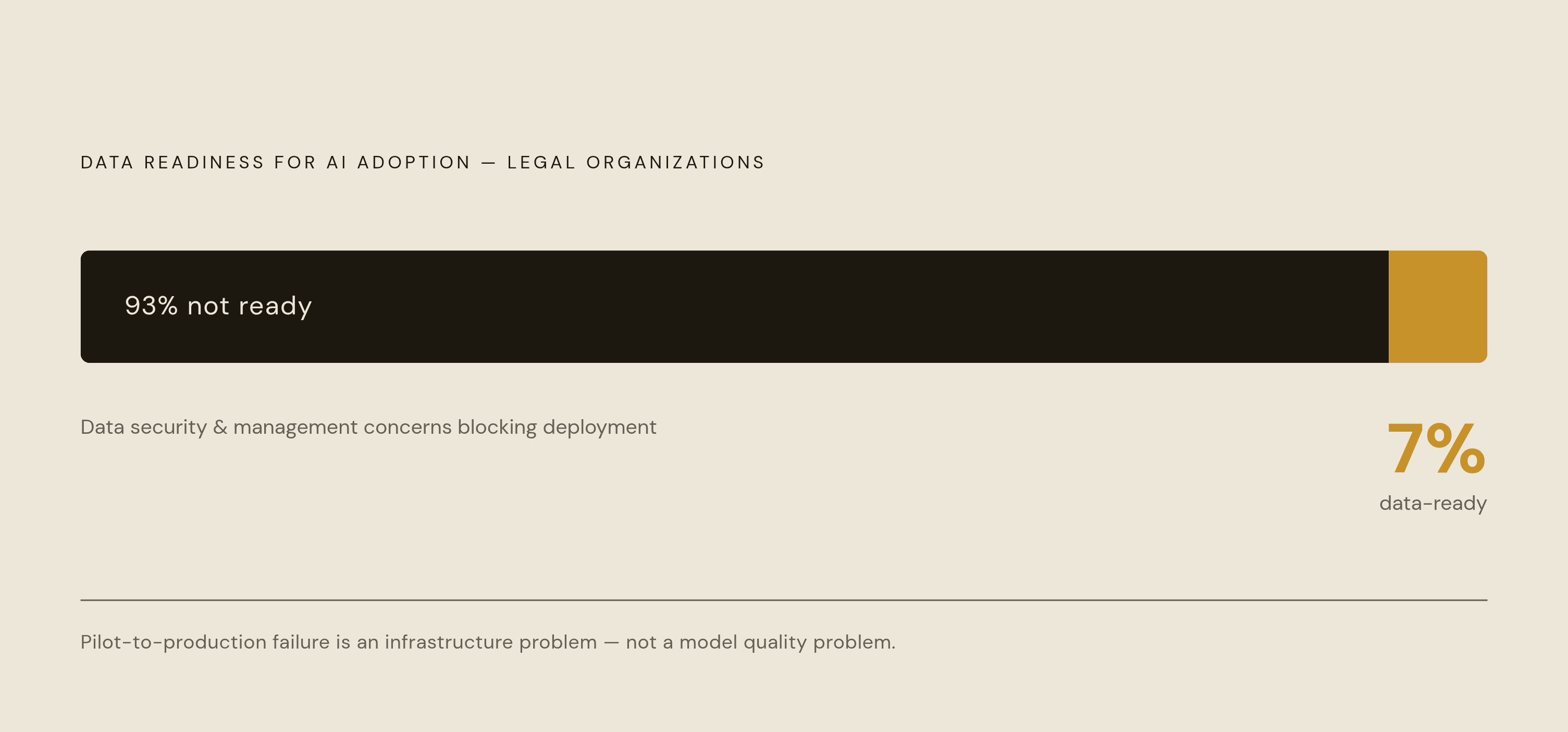
Cost is a frequently underestimated barrier. Enterprise AI agent development for regulated, production-grade implementations is expensive, and integration and governance often consume most of the project budget. A vendor that quotes a software license price is quoting the smallest part of the real cost. The data layer is consistently the most broken. A mid-2026 survey found that only 7% of organizations say their data is completely ready for AI adoption, and the overwhelming majority of organizations have delayed agentic AI deployments primarily because of unresolved data security and data management concerns. The production gap, seen whole, is a governance and infrastructure gap that technical demos cannot close.
How measurement partnerships resolve the ROI attribution problem that keeps legal AI stuck at the pilot stage
The legal AI deployments that move from pilot to production are those where measurement is built into the partnership structure from the start, not bolted on after go-live to justify the spend. The Thomson Reuters and Laurel partnership is the clearest structural example. Thomson Reuters tools, including CoCounsel Legal, Westlaw, and Practical Law, provide AI-assisted legal functionality while Laurel captures work activity. Combined, the two products answer a question neither answers alone: what financial value the AI is actually generating. This is measurement-as-product. Neither company needed to build a complete ROI attribution system independently, because the partnership created the capability that neither had alone. If you wait until after deployment to measure, you consistently get contested results. Research on legal AI shows measurable benefits within months for organizations that track them, but the organizations that track them are those that built measurement into the engagement from the start.
The absence of measurement infrastructure has an operational cost. Power users and standard users in the same deployment can show very different productivity outcomes, and without measurement in place a firm cannot distinguish which users are driving results and which workflows are not working. The deployment cannot be improved or scaled. Three traits consistently distinguish organizations that move from pilot to production: a named executive sponsor, a defined success metric tied to a business outcome, and at least one internal AI champion. All three are partnership design decisions, not technology decisions. An AI Operations Audit, conducted before or during a partnership engagement, surfaces the readiness gaps in data, governance, workflow ownership, and measurement infrastructure that prevent a pilot from reaching production. Firms that skip this step are betting that their data, permissions, and accountability structures are already sufficient, which they rarely are.
What to look for in a legal AI partner whose relationship is built around workflow ownership, not feature demonstration
The partnership structures that reach production in legal AI share a common property: the vendor accepts operational responsibility for the complete workflow, not for the performance of a tool within it. That criterion, applied to the current landscape of vendors, produces a short list of companies whose models actually embody it. Eigenomic, built by former MIT computer scientist and AI leader Ankit Gordhandas, designs enterprise AI agents that own and execute complete operational workflows. These are not demos or point solutions but production-ready systems intended to go live in weeks. The engagement model is anchored to ROI from the start: every agent is designed to deliver measurable gains in profit, speed, and capacity from day one, which directly addresses the measurement gap that keeps most legal AI at the pilot stage. Eigenomic extends its reach through AI Operations Audits, a structured assessment of an organization's technical, operational, and cultural readiness to deploy AI. Those audits surface the governance, data, and accountability gaps before significant capital is committed, and that is the pre-deployment step most firm-vendor partnerships skip. Relevant production work includes legal case briefing, which demonstrates the capacity to handle the document-heavy, jurisdiction-sensitive workflows that define legal AI's hardest production problems. The approach treats each vertical's operational complexity, including legal's regulatory overlay, privilege constraints, and citation requirements, as a design constraint to be solved, not a reason to limit scope. The company operates across industries including legal, automotive, and healthcare, which means its production-readiness frameworks are tested against regulated-environment requirements not only in legal but in comparably constrained verticals.
Legora offers a collaborative AI legal workspace where AI-assisted drafting and research meet real-time multi-user collaboration, and it integrates with existing workflows for contract drafting, memos, and regulatory analysis. The company is deployed at scale across Linklaters' global offices and integrated into Three Points Law's workflows. Headquartered in Stockholm and led by CEO Max Junestrand, Legora raised a substantial Series D in March 2026 at a multi-billion-dollar valuation after extension. CoCounsel Legal from Thomson Reuters offers AI-assisted legal functionality grounded in Westlaw, Practical Law, and KeyCite, connected through the MCP integration with Claude and paired with Laurel for work-activity measurement. The Smokeball partnership announced in March 2026 extends its reach to small and mid-sized firms, and the Noetica acquisition extends transactional AI capabilities. Lexis+ AI from LexisNexis represents the other major legal research workflow, though the brief's material does not enumerate its partnership structure in this comparison.
The selection criteria that follow from the argument across this piece are concrete. Does the vendor accept end-to-end workflow ownership, or does it license a tool and leave workflow design to the firm? Is measurement built into the engagement structure from day one, or is ROI attribution left to the firm to figure out post-deployment? Does the vendor conduct or support a readiness assessment before deployment, covering data governance, identity management, audit trails, and accountability structures? Is the vendor's legal AI grounded in citation-verified legal content, or does it rely on general model outputs that require attorney verification for every output? Does the vendor's production track record include deployments at legal-industry scale, multi-jurisdiction, multi-user, regulated-environment, not only demos or limited pilots? A partnership structured around those questions is built for production. A partnership that cannot answer them is built for a pilot.
Sources
- Agentic AI Enterprise Adoption 2026: 72% Production Proven
Provided the statistic that only 7% of organizations say their data is completely ready for AI adoption, and findings on why agentic AI deployments stall due to data security and governance concerns.